Facebook
 Google
 GitHub
 Linkedin
Discrete Semiconductor Devices and Circuits
Clipper and Clamper Circuits
21 questions By Tony R. Kuphaldt
-
Question 13 of 21
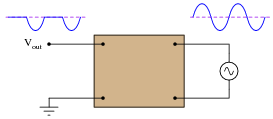
Design a clipper circuit that eliminates the positive portion of this AC waveform, leaving only the negative half-cycles to appear on the output:
Reveal answer
Note: the circuit shown here is not the only possible solution!
Follow-up question: the output waveform shown for this circuit is true only for an ideal diode, not a real diode. Explain what the output waveform would look like if a real diode were used, and recommend a diode model that closely approximates the ideal case for this application.
Notes:A good review of basic diode concepts here. Students should recognize the output waveform as being indicative of half-wave rectification, which may cause them to think of other circuit designs.
-
Question 14 of 21
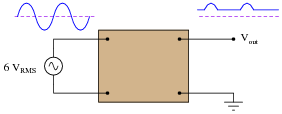
Design a clipper circuit that clips any portion of the input AC waveform below 4 volts:
Reveal answer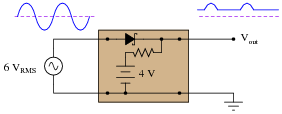
Follow-up question: explain why a Schottky diode is shown in this circuit rather than a regular silicon PN-junction diode. What characteristic(s) of Schottky diodes make them well suited for many clipper applications?
Notes:Ask your students whether they would classify this circuit as a series or a shunt clipper.
If your students are unfamiliar with Schottky diodes, this is an excellent opportunity to discuss them! Their low forward voltage drop and fast switching characteristics make them superior for most signal clipper and clamper circuits.
-
Question 15 of 21
Describe what happens to the shape of the load voltage waveform when the potentiometer is adjusted in this clipper circuit:

Reveal answerThe potentiometer adjusts the threshold at which the positive peak of the AC waveform is clipped.
Follow-up question: modify this circuit to function as a variable negative peak clipper instead.
Notes:Some students may ask what this mathematical statement means:
Rload >> Rseries Explain to them that the “double-chevron” symbol means “much greater than” (reversing the chevrons would mean “much less than,” of course).