Facebook
 Google
 GitHub
 Linkedin
Discrete Semiconductor Devices and Circuits
Clipper and Clamper Circuits
21 questions By Tony R. Kuphaldt
-
Question 16 of 21
There is a problem with this clipper circuit, as evidenced by the output waveform:
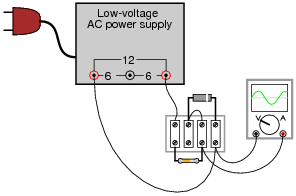
What is the most likely cause of this problem, and how would you verify your conclusion with further measurements?
Reveal answerThe diode might be failed open, but this is only one possibility.
Notes:Have your students figured out any other possibilities for the fault in this circuit? They do exist, and in fact may be more likely than a failed-open diode! Ask your students how and why they chose the answer they did, and be sure to have them explain their follow-up diagnostic procedures.
-
Question 17 of 21
The simplest form of AM radio receiver is the so-called crystal receiver circuit. It gets its name from the very early days of solid-state electronics, when crude signal rectifying diodes were constructed from certain types of mineral crystals:

Explain how the AM radio signal becomes “demodulated” into an audio-frequency signal, through the clipping action of the diode.
Reveal answerThis simple AM “detector” circuit is widely discussed in basic electronics textbooks and other technical literature. There is little I can say here that would expand on what is already written about these circuits. I leave it to you to do the research!
Notes:Ask your students to explain the purpose of each component in the “crystal” radio circuit, not just those components related to the clipping function.
-
Question 18 of 21
Clamper circuits are sometimes referred to as DC restorer circuits. Explain why.
Does a “clamper” circuit change the shape of a voltage waveform, like a “clipper” circuit does? Explain why or why not.
Reveal answer“Clamper” circuits provide just enough DC bias voltage to offset an AC signal so that almost its entire shape occurs either above or below ground potential.
Notes:Ask your students to provide an example of a clamper circuit schematic.