Facebook
 Google
 GitHub
 Linkedin
AC Electric Circuits
Inductive Reactance
13 questions By Tony R. Kuphaldt
-
Question 10 of 13
Explain all the steps necessary to calculate the amount of current in this inductive AC circuit:

Reveal answerI = 15.6 mA
Notes:The current is not difficult to calculate, so obviously the most important aspect of this question is not the math. Rather, it is the procedure of calculation: what to do first, second, third, etc., in obtaining the final answer.
-
Question 11 of 13
A solenoid valve is a mechanical shutoff device actuated by electricity. An electromagnet coil produces an attractive force on an iron “armature” which then either opens or closes a valve mechanism to control the flow of some fluid. Shown here are two different types of illustrations, both showing a solenoid valve:
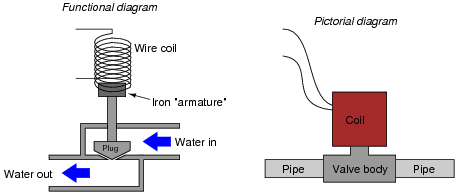
Some solenoid valves are constructed in such a way that the coil assembly may be removed from the valve body, separating these two pieces so that maintenance work may be done on one without interfering with the other. Of course, this means the valve mechanism will no longer be actuated by the magnetic field, but at least one piece may be worked upon without having to remove the other piece from whatever it may be connected to:
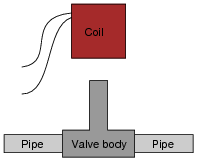
This is commonly done when replacement of the valve mechanism is needed. First, the coil is lifted off the valve mechanism, then the maintenance technician is free to remove the valve body from the pipes and replace it with a new valve body. Lastly, the coil is re-installed on the new valve body and the solenoid is once more ready for service, all without having to electrically disconnect the coil from its power source.
However, if this is done while the coil is energized, it will overheat and burn up in just a few minutes. To prevent this from happening, the maintenance technicians have learned to insert a steel screwdriver through the center hole of the coil while it is removed from the valve body, like this:
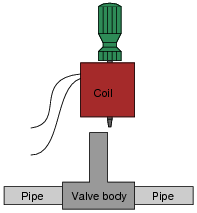
With the steel screwdriver shank taking the place of the iron armature inside the valve body, the coil will not overheat and burn up even if continually powered. Explain the nature of the problem (why the coil tends to burn up when separated from the valve body) and also why a screwdriver put in place of the iron armature works to prevent this from happening.
Reveal answerWith the iron armature no longer in the center of the solenoid coil, the coil’s inductance - and therefore its inductive reactance to AC - dramatically diminishes unless the armature is replaced by something else ferromagnetic.
Notes:When I first saw this practice in action, I almost fell over laughing. It is both practical and ingenious, as well as being an excellent example of variable inductance (and inductive reactance) arising from varying reluctance.
-
Question 12 of 13
When AC power is initially applied to an electric motor (before the motor shaft has an opportunity to start moving), the motor “appears” to the AC power source to be a large inductor:

If the voltage of the 60 Hz AC power source is 480 volts RMS, and the motor initially draws 75 amps RMS when the double-pole single-throw switch closes, how much inductance (L) must the motor windings have? Ignore any wire resistance, and assume the motor’s only opposition to current in a locked-rotor condition is inductive reactance (XL).
Reveal answerXL = 16.98 mH
Notes:In reality, motor winding resistance plays a substantial part in this sort of calculation, but I simplified things a bit just to give students a practical context for their introductory knowledge of inductive reactance.