Facebook
 Google
 GitHub
 Linkedin
Digital Circuits
Numeration Systems
19 questions By Tony R. Kuphaldt
-
Question 16 of 19
When representing non-whole numbers, we extend the “places” of our decimal numeration system past the right of the decimal point, like this:
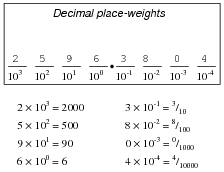
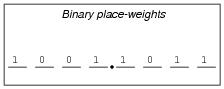
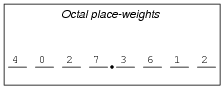
How do you suppose we represent non-whole numbers in a numeration system with a base (or “radix”) other than ten? In the following examples, write the place-weight values underneath each place, and then determine the decimal equivalent of each example number:

Reveal answer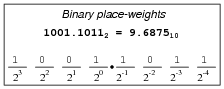


Notes:Many students will not realize initially that it is possible to represent non-whole numbers in binary, octal, or hexadecimal. Really, though, the concept is identical to the representation of non-whole numbers in decimal form. The ability of your students to grasp non-whole numbers in these other numeration systems indicates their grasp of place-weighted systems in general. If a student truly comprehends how place-weighting works, they will have no trouble understanding digits to the left or the right of the radix point in any numeration system. If a student does not understand how digits to the right of the decimal point are interpreted in other numeration systems, then they need to spend more time reviewing what decimal numbers mean.
It’s not that the concept is so hard to understand, so much as it is our familiarity with the decimal (base-ten) numeration system. We grow so accustomed to one way of representing numbers that we don’t realize what the symbols actually mean, or that there may be alternative methods of representing quantities.
-
Question 17 of 19
Convert the following numbers (all between the values of 0 and 1) into decimal form:
- 0.0012 =
- 0.1012 =
- 0.101112 =
- 0.0058 =
- 0.3478 =
- 0.340718 =
- 0.00C16 =
- 0.A2F16 =
- 0.A2F0916 =
Reveal answer- 0.0012 = 0.12510
- 0.1012 = 0.62510
- 0.101112 = 0.7187510
- 0.0058 = 0.00976562510
- 0.3478 = 0.45117187510
- 0.340718 = 0.43923950210
- 0.00C16 = 0.00292968810
- 0.A2F16 = 0.63647460910
- 0.A2F0916 = 0.63648319210
Notes:Ask your students to explain the method of conversion used in each case. It is rather simple, but important to understand nonetheless. Ask your students how this method compares with the conversion of whole-number values into decimal form.
-
Question 18 of 19
Complete this table, performing all necessary conversions between numeration systems. Truncate all answers to three characters past the point:

Reveal answer
Notes:Lots of conversions to do here! I particularly like the “table” format shown here for practicing numeration system conversions, because it compresses a lot of practice into a small space on paper, and also because it allows students to use different methods of conversion. For example, in converting a decimal number to the other forms, a student might choose to convert first to binary, then from binary to octal and hex. Or, alternatively, a student may choose to convert from decimal into hex, then from hex into binary, then from binary to octal, the last two conversions being especially easy.