Facebook
 Google
 GitHub
 Linkedin
DC Electric Circuits
Potentiometers
18 questions By Tony R. Kuphaldt
-
Question 10 of 18
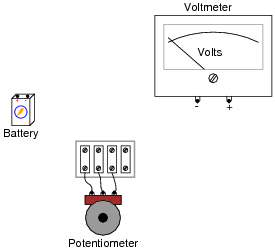
Connect the necessary wires in this illustration to make the potentiometer act as a variable voltage divider, providing a variable voltage to the voltmeter:
Reveal answer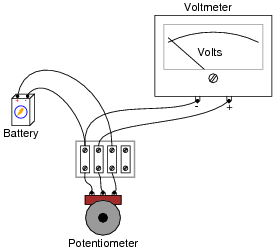
Here’s a hint for those unfamiliar with the internal construction of rotary potentiometers:

Notes:A good follow-up question to this would be to ask your students which way the potentiometer knob needs to be turned in order to increase the voltage applied to the meter.
-
Question 11 of 18
With a trough of water and three pieces of wire, you could make a liquid potentiometer:
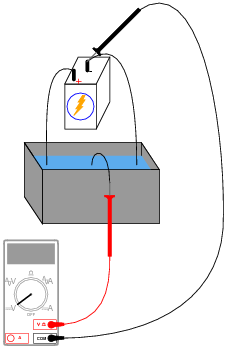
Which way would you have to move the middle wire (the one touching the voltmeter’s red test lead) in order to increase the voltmeter’s reading?
Reveal answerMove the wire to the left in order to make the voltmeter register a greater voltage.
Follow-up question: identify any advantages and disadvantages of such a “liquid pot” over standard potentiometers using solid pieces. Are there any potential safety hazards that occur to you as you look at the illustration of this liquid potentiometer?
Notes:Believe it or not, I have actually seen an application in industry where a “liquid rheostat” (not a potentiometer, but close) was used rather than a device made from solid parts. Very interesting. Very dangerous as well, since it was being used as part of a large motor speed control circuit, handling many amps of current at potentially deadly voltages! I do not know what maniac thought of building this contraption, but it was built and had been working for a number of years.
-
Question 12 of 18
Which way would you have to move the potentiometer wiper, to the left or to the right, in order to increase current through resistor R1?

Reveal answerYou would have to move the potentiometer wiper to the left.
Follow-up question: what would happen to the current through resistor R2 as you moved the wiper in that direction (closer to resistor R1)?
Notes:This circuit is fairly self-explanatory.