Facebook
 Google
 GitHub
 Linkedin
DC Electric Circuits
Potentiometers
18 questions By Tony R. Kuphaldt
-
Question 4 of 18
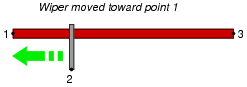
Suppose a length of resistive material (such as nichrome wire) had three points of electrical contact: one at each end (points 1 and 3), plus a movable metal “wiper” making contact at some point between the two ends (point 2):

Describe what happens to the amount of electrical resistance between the following points, as the wiper is moved toward the left end of the resistive element (toward point 1)? State your answers in terms of “increase,” “decrease,” or “remains the same,” and explain why each answer is so.
- Between points 1 and 2, resistance . . .
- Between points 2 and 3, resistance . . .
- Between points 1 and 3, resistance . . .
Reveal answerAs the wiper moves to the left (toward point 1):
- Between points 1 and 2, resistance decreases
- Between points 2 and 3, resistance increases
- Between points 1 and 3, resistance remains the same
Notes:The purpose of this question is to get students to comprehend the function of a potentiometer, before they have ever seen one.
-
Question 5 of 18
A technician decides to use a potentiometer as a speed control for an electric motor. The potentiometer has a resistance rating of 10 Ω and a power rating of 25 watts:

When operating the motor at a voltage of 16 volts and a current of 2 amps, though, smoke begins to pour out of the potentiometer, indicating that its power rating is being exceeded.
The technician is perplexed! According to his calculations, the potentiometer should be dissipating less than 25 watts of power. Why, then, is a potentiometer rated for 25 watts burning up under this condition?
Reveal answerThe power rating of a potentiometer is based on the heat dispersing ability of the entire resistive element. The actual power dissipation rating of a potentiometer must be “de-rated” for wiper positions not utilizing the whole length of the resistive element.
Challenge question: based on the voltage and current values measured in this circuit (16 volts across the motor, 24 volts from the source, and 2 amps of current through it all), determine how badly the potentiometer is being overpowered. In other words, calculate the de-rated power rating of the potentiometer and compare that against the amount of power it is actually dissipating in this condition.
Notes:A very practical and important lesson, learned after watching students send many potentiometers to an early demise.
In order to answer the challenge question, students must determine the pot’s setting as a percentage between 0% (0 Ω) and 100% (10 Ω), and use that setting to estimate power de-rating. It is safe to assume a linear power derating proportional to wiper position.
-
Question 6 of 18
When potentiometers are used as variable resistors (rheostats), the unused terminal is often connected to the wiper terminal:
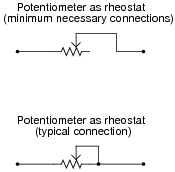
Explain what advantage is gained by connecting the wiper to the unused terminal. Why is the lower potentiometer connection scheme more commonly used than the upper?
Reveal answerHere is a hint: suppose the potentiometer becomes worn with use, to the point where the wiper occasionally loses electrical contact with the resistive element. How would these two connection schemes compare, then?
Notes:This is an example of “defensive engineering”: designing something with eventual failure in mind, with the goal of minimizing the consequences of that inevitable failure. Whether your students go on to become engineers, or simply technicians, it is important for them to think past the immediate application and design issues, to consider what may happen as their system ages.