Facebook
 Google
 GitHub
 Linkedin
DC Electric Circuits
Potentiometers
18 questions By Tony R. Kuphaldt
-
Question 16 of 18
Calculate the voltmeter voltage in each of these circuits, assuming the wiper position is 25% up from the bottom:
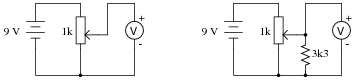
Reveal answerVoltmeter in left-hand circuit = 2.25 volts
Voltmeter in right-hand circuit = 2.13 volts
Notes:Challenge your students to explain the significance of the reduced voltage from the potentiometer in the presence of a load (the 3.3 kΩ resistor). What impact could this effect have on a circuit we might build, where we expect the potentiometer to output a certain voltage corresponding to a specific wiper position?
-
Question 17 of 18
Suppose we were building a circuit that required an adjustable resistance with a range of 1500 Ω to 4500 Ω. The only potentiometer we have on hand is a 10 kΩ unit. Of course, we could simply connect the potentiometer as-is and have an adjustable range of 0 Ω to 10,000 Ω, but that would be too “coarse” of an adjustment for our application.
Explain how we could connect other resistors to this 10 kΩ potentiometer in order to achieve the desired adjustable resistance range.
Reveal answerI’ll give you a hint:

Notes:Knowing how to limit the adjustable range of a potentiometer is a very useful skill when designing and building circuits where precision of adjustment is important. The only drawback to building such a sub-circuit is that the adjustment becomes nonlinear (i.e., setting the potentiometer to the half-way position does not result in the total resistance being 50% of the way between the lower and upper range values).
-
Question 18 of 18
Find one or two real potentiometers and bring them with you to class for discussion. Identify as much information as you can about your potentiometers prior to discussion:
- Resistance (ideal)
- Resistance (actual)
- Taper (linear or audio)
- Number of turns
- Power rating
- Type (carbon composition, wire-wound, etc.)
Reveal answerIf possible, find a manufacturer’s datasheet for your components (or at least a datasheet for a similar component) to discuss with your classmates.
Be prepared to prove the type of taper that your potentiometers have in class, by using a multimeter!
Notes:The purpose of this question is to get students to kinesthetically interact with the subject matter. It may seem silly to have students engage in a “show and tell” exercise, but I have found that activities such as this greatly help some students. For those learners who are kinesthetic in nature, it is a great help to actually touch real components while they’re learning about their function. Of course, this question also provides an excellent opportunity for them to practice interpreting component markings, use a multimeter, access datasheets, etc.