Facebook
 Google
 GitHub
 Linkedin
Basic Electricity
Simple Circuits
41 questions By Tony R. Kuphaldt
-
Question 31 of 41
What would happen if a multimeter were connected across the component labeled “C1” on this printed circuit board, as shown?
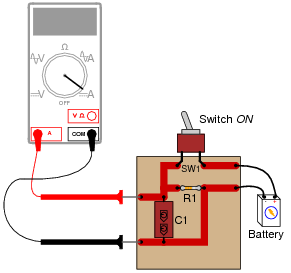
Reveal answerThe meter would create a short-circuit with the battery. Determine what damage this short-circuit might cause, to all components involved.
Notes:Even though it might not appear that the meter is “shorting” the battery in this example, it most certainly is. In asking students to determine the resulting damage from such an action, it is important for them to trace the path of “fault current” through the circuit. Those components within the path of fault current are in risk of damage, while those components not within the path of fault current are not at risk.
-
Question 32 of 41
Explain how an ohmmeter is able to measure the resistance of a component (in this case, a light bulb) when there is no battery or other source of power connected to it:
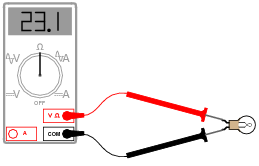
Also, identify the reading you would expect the ohmmeter to indicate if the light bulb were burnt out (failed “open”).
Reveal answerOhmmeters always contain a battery or some other internal source of electrical power so that the component under test may be supplied with a small amount of current, in order to measure how hard it is for current to go through.
If the light bulb were burnt open, the ohmmeter would register an extremely large (infinite) amount of resistance.
Notes:Unlike voltmeters or ammeters, ohmmeters must contain their own power sources. An implication of this fact is that ohmmeters must never be used to measure the resistance of an energized component. Discuss this important caveat with your students, being sure to ask them to explain why connecting an ohmmeter to an energized component might give erroneous measurements (if it doesn’t destroy the meter first!).
In regard to the ohmmeter reading for an open bulb, I have found that many math-weak students have a difficult time grasping the differentiating zero from infinity. They recognize both as being extreme conditions (nothing versus everything), but many make the mistake of regarding “infinity” as identical to zero. Quite to the contrary,“infinity” means bigger than big, and huger than huge. Do not be surprised if one or more of your students harbor this same misconception, and be ready to address it!
-
Question 33 of 41
Shown here is a circuit constructed on a PCB (a “Printed Circuit Board”), with copper “traces” serving as wires to connect the components together:
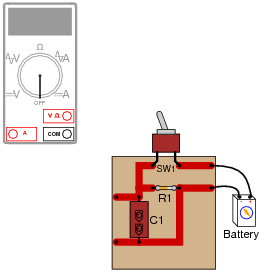
How would the multimeter be used to measure the resistance of the component labeled “R1”? Include these important points in your answer:
- • The configuration of the multimeter (selector switch position, test lead jacks)
- • The connections of the meter test leads to the circuit
- • The state of the switch on the PCB (open or closed)
Reveal answer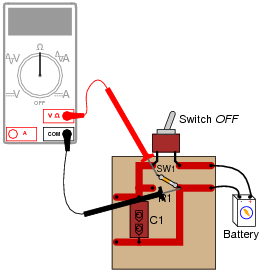
Notes:It is very important that students understand component resistance cannot be measured when the component is energized! In cases such as this, it is necessary to disconnect the component from the rest of the circuit so that only its resistance (and not any other components’ resistance) is measured. In other cases, though, it may be acceptable to leave the component in place to take a resistance measurement.