Facebook
 Google
 GitHub
 Linkedin
Basic Electricity
Simple Circuits
41 questions By Tony R. Kuphaldt
-
Question 4 of 41
What will this voltmeter register when connected to a battery as shown (assume a battery voltage of 6 volts)? Explain your answer.
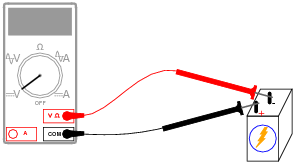
Reveal answerThe voltmeter will register -6 volts.
What do you suppose will happen if the voltmeter is of the analog style (with a moving “needle” rather than a numerical display)?
Notes:Ask the students how an analog (moving pointer) style of voltmeter would respond in this situation. This question lends itself very well to simple experimentation in the classroom, even during discussion time. Learn how to use a voltmeter.
-
Question 5 of 41
Determine what these four voltmeters (A, B, C, D) will register when connected to this circuit in the following positions (assume a battery voltage of 6 volts):
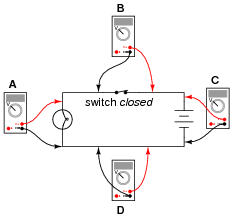
- • Voltmeter A =
- • Voltmeter B =
- • Voltmeter C =
- • Voltmeter D =
Reveal answer- • Voltmeter A = 6 volts
- • Voltmeter B = 0 volts
- • Voltmeter C = 6 volts
- • Voltmeter D = 0 volts
Notes:Students often find the terms “open” and “closed” to be confusing with reference to electrical switches, because they sound opposite to the function of a door (i.e. you can only go through an open door, but electricity can only go through a closed switch!). The words actually make sense, though, if you look at the schematic symbol for an electrical switch as a door mounted “sideways” in the circuit. At least visually, then, “open” and “closed” will have common references.
One analogy to use for the switch’s function that makes sense with the schematic is a drawbridge: when the bridge is down (closed), cars may cross; when the bridge is up (open), cars cannot.
I have found that the concept of electrically common points is most helpful when students first learn to relate voltage drop with continuity (breaks or non-breaks) in a circuit.
To be able to immediately relate the expected voltage drop between two points with the electrical continuity between those points is a very important foundational skill in electrical troubleshooting. Without mastery of this skill, students will have great difficulty detecting and correcting faults in circuits caused by poor connections and broken wires, which constitute a fair portion of realistic circuit failures.
-
Question 6 of 41
Determine what these four voltmeters (A, B, C, D) will register when connected to this circuit in the following positions (assume a battery voltage of 6 volts):
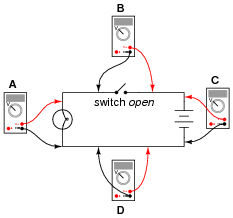
- • Voltmeter A =
- • Voltmeter B =
- • Voltmeter C =
- • Voltmeter D =
Reveal answer- • Voltmeter A = 0 volts
- • Voltmeter B = 6 volts
- • Voltmeter C = 6 volts
- • Voltmeter D = 0 volts
Notes:Students often find the terms “open” and “closed” to be confusing with reference to electrical switches, because they sound opposite to the function of a door (i.e. you can only go through an open door, but electricity can only go through a closed switch!). The words actually make sense, though, if you look at the schematic symbol for an electrical switch as a door mounted “sideways” in the circuit. At least visually, then, “open” and “closed” will have common references.
One analogy to use for the switch’s function that makes sense with the schematic is a drawbridge: when the bridge is down (closed), cars may cross; when the bridge is up (open), cars cannot.
I have found that the concept of electrically common points is most helpful when students first learn to relate voltage drop with continuity (breaks or non-breaks) in a circuit.
To be able to immediately relate the expected voltage drop between two points with the electrical continuity between those points is a very important foundational skill in electrical troubleshooting. Without mastery of this skill, students will have great difficulty detecting and correcting faults in circuits caused by poor connections and broken wires, which constitute a fair portion of realistic circuit failures.