Facebook
 Google
 GitHub
 Linkedin
Basic Electricity
Simple Circuits
41 questions By Tony R. Kuphaldt
-
Question 13 of 41
Electric motors of the permanent magnet design are very simple to reverse: just switch the polarity of the DC power to the motor, and it will spin the other direction:
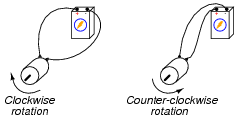
Complete this schematic diagram, showing how a DPDT switch may be placed in this circuit to reverse the motor’s direction of rotation without the need to disconnect and re-connect wires:

Reveal answer
Notes:DPDT switches are often used as polarity-reversal devices. No doubt your students will see (or build!) this switch arrangement some time in their careers.
-
Question 14 of 41
What will the light bulb do when the switch is open, and when the switch is closed?

Reveal answerWhen the switch is closed, the light bulb will receive full voltage from the battery. When the switch is open, the light bulb will receive less voltage (and correspondingly, less current).
Notes:This is another opportunity to review the meanings of “open” and “closed” with regard to switches. Again, students new to electricity often exhibit confusion over these terms, because in the context of doors they hold opposite meanings.
-
Question 15 of 41
Examine this schematic diagram:

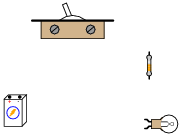
Now, without moving the following components, show how they may be connected together with wires to form the same circuit depicted in the schematic diagram above:
Reveal answer
Notes:One of the more difficult skills for students to develop is the ability to translate a nice, neat schematic diagram into a messy, real-world circuit, and visa-versa. Developing this skill requires lots of practice.
It is very worthwhile for students to discuss how they solve problems such as these with each other. For those students who have trouble visualizing shapes, a simple hint or “trick” to use when translating schematics to illustrations or visa-versa may be invaluable.