Facebook
 Google
 GitHub
 Linkedin
Analog Integrated Circuits
Summer and Subtractor OpAmp Circuits
25 questions By Tony R. Kuphaldt
-
Question 16 of 25
Find the datasheet for a real instrumentation amplifier (packaged as a single integrated circuit) and bring it to class for discussion with your classmates. Analyze and discuss the inner workings of the circuit, and some of its performance parameters. If you do not know where to begin looking, try researching the Analog Devices model AD623, either in a reference book or on the internet.
Reveal answerI’ll leave the discussion up to you and your classmates. With any luck, you should have found some example circuits showing how the instrumentation amplifier may be used, or possibly some application notes to complement the datasheet.
Notes:The idea of this question is to get students researching real integrated circuit applications, to teach them how to do this research and also how to interpret what they find. Since there are so many high-quality instrumentation amplifiers already built and packaged as monolithic units, it is usually not worth the technician’s time to fabricate one from individual opamps. However, when specifying a pre-built instrumentation amplifier, it is essential to know what you need and how to use it once it arrives!
-
Question 17 of 25
The following circuit is a type of difference amplifier, similar in behavior to the instrumentation amplifier, but only using two operational amplifiers instead of three:
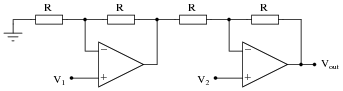
Complete the table of values for this opamp circuit, calculating the output voltage for each combination of input voltages shown. From the calculated values of output voltage, determine which input of this circuit is inverting, and which is non-inverting, and also how much differential voltage gain this circuit has. Express these conclusions in the form of an equation.
V1 V2 Vout
0 V 0 V
1 V 0 V
0 V 1 V
2 V 1.5 V
3.4 V 1.2 V
-2 V 4 V
5 V 5 V
-3 V -3 V
Reveal answer
V1 V2 Vout
0 V 0 V 0 V
1 V 0 V -2 V
0 V 1 V 2 V
2 V 1.5 V -1 V
3.4 V 1.2 V -4.4 V
-2 V 4 V 12 V
5 V 5 V 0 V
-3 V -3 V 0 V
Vout = 2(V2 − V1) Follow-up question: explain how this circuit is at once similar and different from the popular ïnstrumentation amplifier” circuit.
Notes:Although it would be easy enough just to tell students which input is inverting and which input is non-inverting, they will learn more (and practice their analysis skills more) if asked to work through the table of values to figure it out.
-
Question 18 of 25
An important parameter of any differential amplifier - bare opamps and difference amplifiers made from opamps alike - is common-mode rejection, or CMR. Explain what this parameter means, how the following circuit tests this parameter, and why it is important to us:

Reveal answerCMR measures the degree to which a differential amplifier ignores common-mode signals.
Follow-up question: what range of CMR values would you expect from a good differential amplifier, if subjected to the test shown in the schematic and CMR calculated by the given formula?
Notes:In case some students do not recall (!), the logarithmic formula is nothing special. It simply provides an answer in units of decibels.