Facebook
 Google
 GitHub
 Linkedin
AC Electric Circuits
AC Generator Theory
13 questions By Tony R. Kuphaldt
-
Question 4 of 13
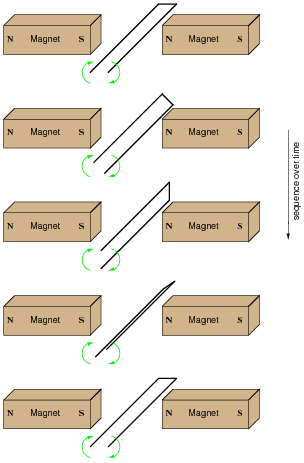
Determine the polarity of induced voltage between the ends of this wire loop, as it is rotated between the two magnets:
Reveal answer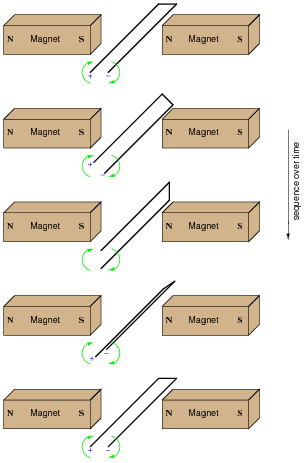
Challenge question: if a resistor were connected between the ends of this wire loop, would it “see” direct current (DC), or alternating current (AC)?
Notes:Note that the two wire ends switch polarity as the loop rotates. Ask your students to explain why the polarities are as they are.
-
Question 5 of 13
Describe the nature of the voltage induced in the stationary (“stator”) windings, as the permanent magnet rotor rotates in this machine:
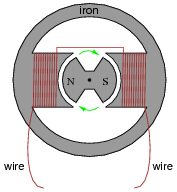
What factors determine the magnitude of this voltage? According to Faraday’s Law, what factors can we alter to increase the voltage output by this generator?
Is the induced voltage AC or DC? How can you tell?
Reveal answerIncrease the [(dφ)/dt] rate of change, or increase the number of turns in the stator winding, to increase the magnitude of the AC voltage generated by this machine.
Follow-up question: AC generators, or alternators as they are sometimes called, are typically long-lived machines when operated under proper conditions. But like all machines, they will eventually fail. Based on the illustration given in the question, identify some probable modes of failure for an alternator, and what conditions might hasten such failures.
Notes:Ask your students to write the equation for Faraday’s Law on the whiteboard, and then analyze it in a qualitative sense (with variables increasing or decreasing in value) to validate the answers.
The first answer to this question (increase [(dφ)/dt]) has been left purposefully vague, in order to make students think. What, specifically, must be changed in order to increase this rate-of-change over time? Which real-world variables are changeable after the generator has been manufactured, and which are not?
-
Question 6 of 13
In order to make the most practical AC generator (or alternator, as it is also known), which design makes more sense: a stationary permanent magnet with a rotating wire coil, or a rotating permanent magnet with a stationary wire coil? Explain your choice.
Reveal answerIt is more practical by far to build an alternator with a stationary wire coil and a rotating magnet than to build one with a stationary magnet and a rotating wire coil, because a machine with a rotating coil would require some form of brushes and slip rings to conduct power from the rotating shaft to the load.
Follow-up question: what is so bad about brushes and slip rings that we want to avoid them in alternator design if possible?
Notes:Answering the follow-up question may require a bit of research on the part of your students. Ask them to describe what “brushes” are and what “slip rings” are, and then the mechanical wearing aspects of these parts should become plain.