Facebook
 Google
 GitHub
 Linkedin
AC Electric Circuits
AC Generator Theory
13 questions By Tony R. Kuphaldt
-
Question 10 of 13
How many poles does an alternator have if it generates 400 Hz power at a shaft speed of 6000 RPM?
Reveal answer8 poles, which is the same as 4 pole pairs.
Follow-up question: algebraically manipulate the speed/poles/frequency equation to solve for the frequency generated (f) given the number of poles (N) and the generator speed (S).
Notes:Some references provide equations in terms of pole pairs instead of individual alternator poles.
-
Question 11 of 13
Assuming that the output frequency of an alternator must remain constant (as is the case in national power systems, where the frequency of all power plants must be the same), how may its output voltage be regulated? In other words, since we do not have the luxury of increasing or decreasing its rotational speed to control voltage, since that would change the frequency, how can we coax the alternator to produce more or less voltage on demand?
Hint: automotive alternators are manufactured with this feature, though the purpose in that application is to maintain constant voltage despite changes in engine speed. In automotive electrical systems, the frequency of the alternator’s output is irrelevant because the AC is “rectified” into DC (frequency = 0 Hz) to charge the battery.
Reveal answerThe rotor cannot be a permanent magnet, but must be an electromagnet, where we can change its magnetic field strength at will.
Follow-up question: how is it possible to conduct electric power to windings on a spinning rotor? Should we energize the rotor winding with AC or DC? Explain your answer.
Notes:Ask your students how this voltage regulation strategy compares with that of DC generators. Ask them to describe the difference between “commutator bars” and “slip rings.”
-
Question 12 of 13
Suppose we have an alternator with two sets of windings, A and B:
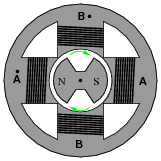
Each pair of windings in each set is series-connected, so they act as just two separate windings:

If one end of each winding pair were connected together at a common ground point, and each winding pair output 70 volts RMS, how much voltage would be measured between the open winding pair ends?
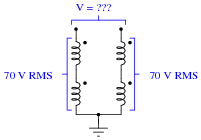
Reveal answer99 volts
Hint: if you don’t understand how this voltage value was calculated, plot the voltage output of the two windings as if they were shown on an oscilloscope. The phase relationship between the two voltages is key to the solution.
Follow-up question: draw a phasor diagram showing how the difference in potential (voltage) between the wire ends is equal to 99 volts, when each winding coil’s voltage is 70 volts.
Notes:This question is a good exercise of students’ knowledge of phase shift, in a very practical context.