Facebook
 Google
 GitHub
 Linkedin
AC Electric Circuits
AC Generator Theory
13 questions By Tony R. Kuphaldt
-
Question 7 of 13
We know that in order to induce a sinusoidal voltage in a wire coil, the magnetic flux linking the turns of wire in the coil must follow a sinusoidal path over time, phase-shifted 90o from the voltage waveform. This relationship between flux and induced voltage is expressed in Faraday’s equation v = N [(dφ)/dt]:
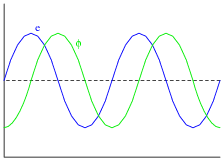
Based on this fact, draw the position of the magnetic rotor in this alternator when the voltage is at one of its peaks:
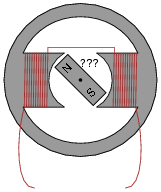
Reveal answerThe alternator voltage peaks when the magnetic flux is at the zero-crossover point:
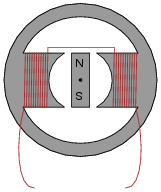
(The actual magnet polarities are not essential to the answer. Without knowing which way the coils were wound and which way the rotor is spinning, it is impossible to specify an exact magnetic polarity, so if your answer had “N” facing down and “S” facing up, it’s still acceptable.)
Notes:This question challenges students to relate the magnetic flux waveform (φ) to an instantaneous rotor position. The answer may come as a surprise to some, who expected maximum induced voltage to occur when the rotor is in-line with the stator poles. This answer, however, makes the mistake of confusing flux (φ) with rate-of-flux-change over time ([(dφ)/dt]). A rotor lined up with the stator poles would result in maximum flux (φ) through those poles, but not maximum rate-of-flux-change over time ([(dφ)/dt]).
-
Question 8 of 13
If this alternator is spun at 4500 RPM (revolutions per minute), what will be the frequency of its output voltage?
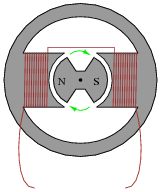
Hint: how many cycles of AC are produced for every revolution of the rotor?
Reveal answerf = 75 Hz
Notes:Students should realize that there is one cycle of AC voltage produced for every revolution of the rotor shaft. From that point, the problem is simply a matter of unit conversions.
-
Question 9 of 13
How fast must a 12-pole alternator spin in order to produce 60 Hz AC power? Write a mathematical equation solving for speed (S) in terms of frequency (f) and the number of poles (N).
Reveal answerS = 600 RPM, for f = 60 Hz.
S = 120 f NFollow-up question: algebraically manipulate this equation to solve for the number of poles (N) needed in a generator given speed (S) and frequency (f).
Notes:This may be especially confusing to some students, until they realize that alternator poles are always multiples of 2 (the simplest alternator having 2 poles).