Facebook
 Google
 GitHub
 Linkedin
AC Electric Circuits
AC Waveforms
10 questions By Tony R. Kuphaldt
-
Question 4 of 10
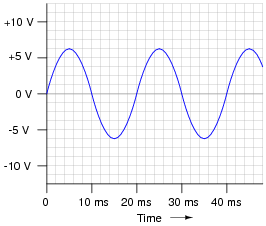
Apply the following terms to this graph of an AC voltage measured over time:
- Frequency
- Period
- Hertz
- Amplitude
Reveal answer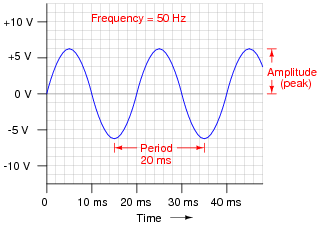
Notes:As always, it is more important to be able to apply a term to a real-life example than it is to memorize a definition for that term. In my experience, many students prefer to memorize definitions for terms rather than to go through the trouble of understanding how those terms apply to real life. Make sure students realize just how and why these AC terms apply to a waveform such as this.
-
Question 5 of 10
Frequency used to be expressed in units of cycles per second, abbreviated as CPS. Now, the standardized unit is Hertz. Explain the meaning of the obsolete frequency unit: what, exactly, does it mean for an AC voltage or current to have x number of “cycles per second?”
Reveal answerEach time an AC voltage or current repeats itself, that interval is called a cycle. Frequency, being the rate at which an AC voltage or current repeats itself over time, may be represented in terms of cycles (repetitions) per second.
Notes:Encourage your students to discuss the origins of the new unit (Hertz), and how it actually communicates less information about the thing being measured than the old unit (CPS).
-
Question 6 of 10
If an AC voltage has a frequency of 350 Hz, how long (in time) is its period?
Reveal answerPeriod = 2.8571 milliseconds
Notes:It is important for students to realize the reciprocal relationship between frequency and period. One is cycles per second while the other is seconds per cycle.