Facebook
 Google
 GitHub
 Linkedin
AC Electric Circuits
AC Waveforms
10 questions By Tony R. Kuphaldt
-
Question 7 of 10
If the only instrument you had in your possession to detect AC voltage signals was an audio speaker, how could you use it to determine which of two AC voltage waveforms has the greatest period?
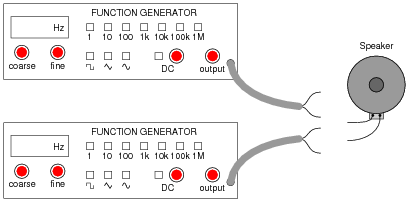
Reveal answerConnecting the speaker to each AC voltage source, one at a time, will result in two different audio tones output by the speaker. Whichever tone is lower in pitch is the waveform with the greatest period.
Notes:An audio speaker is an outstanding instrument to use in teaching AC theory, because it makes use of a human sense that most instruments do not. I have constructed a simple headphone-based listening instrument for my own lab use, and have found it invaluable, especially in the absence of an oscilloscope. There is so much the trained ear may discern about an AC waveform based on volume and tone!
-
Question 8 of 10
Determine the frequency of a waveform having a period of 1.4 milliseconds (1.4 ms).
Reveal answerf = 714.29 Hz
Notes:It is important for students to realize the reciprocal relationship between frequency and period. One is cycles per second while the other is seconds per cycle.
-
Question 9 of 10
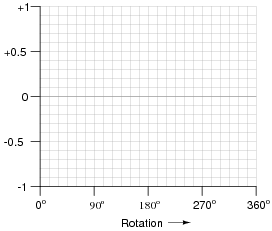
Alternating current produced by electromechanical generators (or alternators as they are sometimes designated) typically follows a sine-wave pattern over time. Using a calculator, or a set of “trig tables,” plot a sine wave on the following graph:
Reveal answer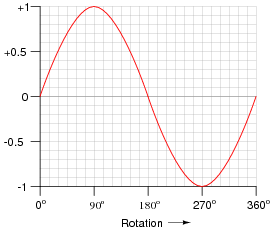
Notes:For many students, this might be the first time they realize trigonometry functions have anything to do with electricity! That voltage and current in an AC circuit might alternate according to a mathematical function available in their calculators is something of a revelation. Be prepared to discuss why rotating electromagnetic machines naturally produce such waveforms. Also, encourage students to make the cognitive connection between the independent variable of a sine function (angle, expressed in units of degrees in this question) to actual shaft rotation in a real generator.