Facebook
 Google
 GitHub
 Linkedin
Discrete Semiconductor Devices and Circuits
Conventional Transistor Overview and Special Transistors
13 questions By Tony R. Kuphaldt
-
Question 10 of 13
Identify what each type of transistor is (MOSFET, JFET, or BJT; N-channel, P-channel, NPN, or PNP, E-type or D-type), and what must be connected to the controlling terminal of each transistor (base or gate) to turn each one on so that the light bulb energizes:

Reveal answer
Follow-up question: for the JFET, which is already “on” with zero voltage applied to the gate, describe what would be necessary to force it into the “off” state.
Notes:It is very important for students to understand what conditions are necessary to drive any of these transistor types into their ön” states, as a precursor to understanding their function in linear (analog) circuitry.
-
Question 11 of 13
Identify what each type of transistor is (MOSFET, JFET, or BJT; N-channel, P-channel, NPN, or PNP, E-type or D-type), and what must be connected to the controlling terminal of each transistor (base or gate) to turn each one on so that the light bulb energizes:

Reveal answer
Follow-up question: for the JFET, which is already “on” with zero voltage applied to the gate, describe what would be necessary to force it into the “off” state.
Notes:It is very important for students to understand what conditions are necessary to drive any of these transistor types into their “on” states, as a precursor to understanding their function in linear (analog) circuitry.
-
Question 12 of 13
Shown here is the schematic diagram for a simple automotive ignition system, to produce pulses of high voltage sufficient to energize spark plugs in an engine:
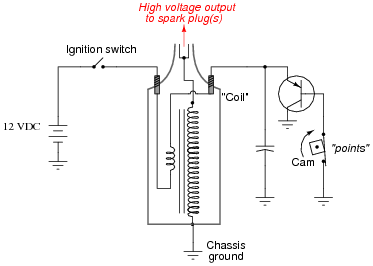
An engineer decides to replace the BJT with a MOSFET, and arrives at the following circuit design:

Explain how this revised circuit works. When does the MOSFET conduct current, when the point contacts are open or closed? How does this compare to the working of the previous (BJT) circuit? What purpose does the 10 kΩ resistor serve?
Reveal answerThe MOSFET conducts current when the point contacts are open, which is opposite that of the BJT. I’ll let you figure out what the purpose of the resistor is!
Notes:If this were a real ignition system, the timing would have to be adjusted, as the spark will now be produced every time the points close rather than every time the points open as it did before (with the BJT). Discuss the operation of this circuit with your students, asking them to explain how they know the MOSFET’s status (and the BJT’s status, for that matter).