
 Facebook
 Google
 GitHub
 Linkedin
Digital Circuits
Digital Logic Signals
9 questions By Tony R. Kuphaldt
-
Question 7 of 9
Identify whether each of these quantities is continuous or discrete:
- Resistance of a rheostat:
- Resistance of a switch:
- Time represented by an analog clock:
- Time represented by a digital clock:
- Quantity of money in a billfold (bills and coins):
- Number of pebbles held in a hand:
- A person’s weight, in pounds or kilograms:
- Voltage output by a comparator:
- Voltage output by an operational amplifier:
- Electrical conductivity of a thyristor:
Reveal answer- Resistance of a rheostat: continuous
- Resistance of a switch: discrete
- Time represented by an analog clock: continuous
- Time represented by a digital clock: discrete
- Quantity of money in a billfold (bills and coins): discrete
- Number of pebbles held in a hand: discrete
- A person’s weight, in pounds or kilograms: continuous
- Voltage output by a comparator: discrete
- Voltage output by an operational amplifier: continuous (if negative feedback is applied)
- Electrical conductivity of a thyristor: discrete
Notes:The purpose of this question is to get students thinking in terms of “digital” quantities, which by their very nature are non-continuous. It is important to note that the concepts of continuous and discrete quantities are not limited to electronics, but are found in a variety of places in every-day life.
It should be noted that some of these determinations are subjective. The voltage output by a comparator may be considered discrete on a large time scale, but there is a measurable transition from “high” voltage to “low” voltage in which the output voltage is somewhere between full saturation limits.
-
Question 8 of 9
Two computational aids of antiquity are the abacus and the slide rule. Which of these mathematical instruments would be considered “analog” and which would be considered “digital”? Explain your answer.
Reveal answerSlide rules are analog, while abaci (abacuses?) are digital.
Notes:One challenge to answering this question is for (young) students to figure out what a slide rule is!
-
Question 9 of 9
In digital electronic circuitry, binary bit values of 0 or 1 are represented in the form of voltages: low and high logic states, respectively. Suppose you need to manually “input” a logic state to one of the pins of a logic circuit. In the following illustration, the logic circuit (shown as an indistinct, shaded rectangle) is already supplied with DC power ( V and ground), and its output is indicated by an LED. All it requires is an input from you:
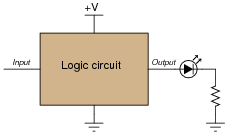
Complete this schematic diagram by including a switch in the drawing, such that in each of its two positions, a definite “low” or “high” logic state will be sensed by the circuit’s input terminal.
Reveal answer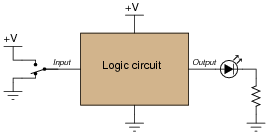
Notes:While this may seem to be a very elementary question, it is important to get students to realize just what logic states are, in their physical representations. Too often I read textbooks and other digital logic tutorials that leap the student immediately into a boolean analysis of gate circuits, with everything operating off of abstract 0’s and 1’s (or “low’s” and “high’s”), without properly introducing the electrical nature of these states to students. Remember, your students should be quite familiar with electrical circuits, including analog transistor and op-amp circuits, by now, so beginning their study of gates from an electrical perspective should be natural for them. Only after they realize how logic states are represented by voltages do I recommend discussing gates and truth tables.


