Facebook
 Google
 GitHub
 Linkedin
Digital Circuits
High-Reliability Circuits
9 questions By Tony R. Kuphaldt
-
Question 4 of 9
An important parameter of high-reliability systems is abbreviated MTBF. What does this acronym stand for?
Reveal answer“MTBF” = Mean Time Between Failures, a statistical figure based on the failure rate of a large batch of continuously operating units.
Notes:It is important for students to realize that an MTBF figure is not to be taken as the amount of time an average component is expected to last. For example, an integrated circuit with an MTBF of 1.5 million hours should not actually be expected to last 1.5 million continuous hours. Its real life will most likely be less than that!
-
Question 5 of 9
The component failure rate of complex systems usually follows a trend known in the industry as the “bathtub curve”:
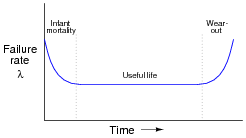
While the “Useful life” and “Wear-out” phases of the system life-cycle are easy to understand, the initial “Infant mortality” phase is not so intuitive. Explain what factors might lead to premature component failure during this initial phase of a system’s lifespan.
Reveal answerGross manufacturing defects, incorrect installation, and design flaws, to name a few.
Follow-up question: is it important to know which phase of the life-cycle a system is in before you begin to troubleshoot a problem in it? Explain your answer.
Notes:The follow-up question is especially important to discuss with your students. Knowing what portion of the life-cycle a system is in can make a huge difference in your troubleshooting effectiveness. Ask your students why this is. If possible, enlighten the discussion with examples from your own professional experience.
-
Question 6 of 9
For the following electronic components, determine whether they are more likely to fail open or fail shorted (this includes partial, or high-resistance, shorts):
- Resistors:
- Capacitors:
- Inductors:
- Switches:
- Transformers:
- Diodes:
- Bipolar transistors:
- Field-effect transistors:
- Crystals:
I encourage you to research information on these devices’ failure modes, as well as glean from your own experiences building and troubleshooting electronic circuits.
Reveal answerRemember that each of these answers merely represents the most likely of the two failure modes, either open or shorted, and that probabilities may shift with operating conditions (i.e. switches may be more prone to failing shorted due to welded contacts if they are routinely abused with excessive current upon closure).
- Resistors: open
- Capacitors: shorted
- Inductors: open or short equally probable
- Switches: open
- Transformers: open or short equally probable
- Diodes: shorted
- Bipolar transistors: shorted
- Field-effect transistors: shorted
- Crystals: open
Notes:Emphasize to your students how a good understanding of common failure modes is important to efficient troubleshooting technique. Knowing which way a particular component is more likely to fail under normal operating conditions enables the troubleshooter to make better judgments when assessing the most probable cause of a system failure.
Of course, proper troubleshooting technique should always reveal the source of trouble, whether or not the troubleshooter has any experience with the failure modes of particular devices. However, possessing a detailed knowledge of failure probabilities allows one to check the most likely sources of trouble first, which generally leads to faster repairs.
A division of the United States Department of Defense (DoD) as the Reliability Analysis Center, or RAC, publishes detailed analyses of failure modes for a wide variety of components, electronic as well as non-electronic. They may be contacted at 201 Mill Street, Rome, New York, 13440-6916. Data for this question was gleaned from the RAC’s 1997 publication, Failure Mode / Mechanism Distributions (FMD-97).