Facebook
 Google
 GitHub
 Linkedin
DC Electric Circuits
Inductors
11 questions By Tony R. Kuphaldt
-
Question 7 of 11
Suppose a short-circuit were to develop in this electric power system:
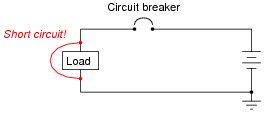
The purpose of the circuit breaker, of course, is to open the circuit automatically, to prevent damage to the power conductors. In a large electric power system, the magnitudes of such short-circuit currents can be enormous.
Large inductors, commonly called reactors, are often installed in series with power conductors in high-voltage power systems in order to “soften” the onset of short-circuit currents:
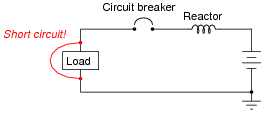
Explain how the addition of a “reactor” helps to minimize the magnitude of the short-circuit current the breaker has to interrupt.
Reveal answerAt the moment that a short-circuit fault occurs, the sudden increase in current constitutes a very large [di/dt] value, which the inductor momentarily “opposes” by dropping voltage.
Follow-up question: why use an inductor to limit the short-circuit fault current? Why not use a resistor instead?
Notes:Power system reactors are usually installed in substations, where they appear as coils of wire (no iron core) a few feet in diameter, usually located near circuit breakers.
-
Question 8 of 11
Small inductors often look like resistors, even to the extent that their values are designated by colored bands. Determine the values of the following inductors (express the tolerance as a percentage), based on their color codes:
- Red, Grn, Brn, Gld
- Wht, Org, Red, Sil
- Grn, Gry, Blk
- Vio, Blu, Org, Gld
Reveal answer- Red, Grn, Brn, Gld = 250 μH, /- 5%
- Wht, Org, Red, Sil = 9300 μH, /- 10%
- Grn, Gry, Blk = 58 μH, /- 20%
- Vio, Blu, Org, Gld = 76 mH, /- 5%
Notes:Students will note a lot of similarities between the inductor color code and the resistor color code, but they should also note one significant difference!
-
Question 9 of 11
When checked with an ohmmeter, how should a properly functioning inductor respond?
Reveal answerA “healthy” inductor should register as a very low resistance between its terminals. If the inductor has an iron core, there should be infinite resistance (no continuity) between either winding terminal and the core.
Follow-up question: what do you suppose is the most likely failure “mode” of an inductor, open or shorted? Explain your answer.
Notes:Have your students actually test a few inductors with their ohmmeters in class. Unlike capacitor checking with an ohmmeter, there is never a substantial “charging” period! If your students have already learned about capacitor checking with an ohmmeter, ask them to explain why there is no “charging” action indicated by the ohmmeter when connected to an inductor.
If there were an observable “charging” time exhibited by an inductor when measured by an ohmmeter, what would it appear as, in terms of the ohmmeter’s indication?
Normally, I don’t give away answers to follow-up questions in the “Notes” section, but here I feel it may be necessary. Studies have shown that inductors have about an equal chance of failing open as they do failing shorted. Of course, this will vary with the specific design and application of the inductor, but there is no mode of failure clearly more probable than the other.