
 Facebook
 Google
 GitHub
 Linkedin
Digital Circuits
Karnaugh Mapping
17 questions By Tony R. Kuphaldt
-
Question 10 of 17
State the rules for properly identifying common groups in a Karnaugh map.
Reveal answerAny good introductory digital textbook will give the rules you need to do Karnaugh mapping. I leave you to research these rules for yourself!
Notes:The answer speaks for itself here - let your students research these rules, and ask them exactly where they found them (including the page numbers in their textbook(s)!).
-
Question 11 of 17
A seven segment decoder is a digital circuit designed to drive a very common type of digital display device: a set of LED (or LCD) segments that render numerals 0 through 9 at the command of a four-bit code:
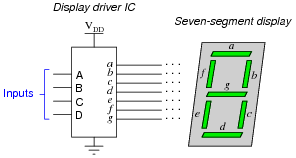
The behavior of the display driver IC may be represented by a truth table with seven outputs: one for each segment of the seven-segment display (a through g). In the following table, a “1” output represents an active display segment, while a “0” output represents an inactive segment:
D C B A a b c d e f g Display
0 0 0 0 1 1 1 1 1 1 0 “0”
0 0 0 1 0 1 1 0 0 0 0 “1”
0 0 1 0 1 1 0 1 1 0 1 “2”
0 0 1 1 1 1 1 1 0 0 1 “3”
0 1 0 0 0 1 1 0 0 1 1 “4”
0 1 0 1 1 0 1 1 0 1 1 “5”
0 1 1 0 1 0 1 1 1 1 1 “6”
0 1 1 1 1 1 1 0 0 0 0 “7”
1 0 0 0 1 1 1 1 1 1 1 “8”
1 0 0 1 1 1 1 1 0 1 1 “9”
A real-life example such as this provides an excellent showcase for techniques such as Karnaugh mapping. Let’s take output a for example, showing it without all the other outputs included in the truth table:
D C B A a
0 0 0 0 1
0 0 0 1 0
0 0 1 0 1
0 0 1 1 1
0 1 0 0 0
0 1 0 1 1
0 1 1 0 1
0 1 1 1 1
1 0 0 0 1
1 0 0 1 1
Plotting a Karnaugh map for output a, we get this result:
Identify adjacent groups of 1’s in this Karnaugh map, and generate a minimal SOP expression from those groupings.
Note that six of the cells are blank because the truth table does not list all the possible input combinations with four variables (A, B, C, and D). With these large gaps in the Karnaugh map, it is difficult to form large groupings of 1’s, and thus the resulting “minimal” SOP expression has several terms.
However, if we do not care about output a’s state in the six non-specified truth table rows, we can fill in the remaining cells of the Karnaugh map with “don’t care” symbols (usually the letter X) and use those cells as “wildcards” in determining groupings:

With this new Karnaugh map, identify adjacent groups of 1’s, and generate a minimal SOP expression from those groupings.
Reveal answerKarnaugh map groupings with strict “1” groups:
$$\overline{D}B+\overline{D}CA+D \ \overline{C} \ \overline{B}+\overline{C} \ \overline{B} \ \overline{A}$$

Karnaugh map groupings with “don’t care” wildcards:
$$D+B+CA+\overline{C}\ \overline{A}$$

Follow-up question: this question and answer merely focused on the a output for the BCD-to-7-segment decoder circuit. Imagine if we were to approach all seven outputs of the decoder circuit in these two fashions, first developing SOP expressions using strict groupings of “1” outputs, and then using “don’t care” wildcards. Which of these two approaches do you suppose would yield the simplest gate circuitry overall? What impact would the two different solutions have on the decoder circuit’s behavior for the six unspecified input combinations 1010, 1011, 1100, 1101, 1110, and 1111?
Notes:One of the points of this question is for students to realize that bigger groups are better, in that they yield simpler SOP terms. Also, students should realize that the ability to use “don’t care” states as “wildcard” placeholders in the Karnaugh map cells increases the chances of creating bigger groups.
Truth be known, I chose a pretty bad example to try to make an SOP expression from, since there are only two non-zero output conditions out of ten! Formulating a POS expression would have been easier, but that’s a subject for another question!
-
Question 12 of 17
When designing a circuit to emulate a truth table such as this where nearly all the input conditions result in “1” output states, it is easier to use Product-of-Sums (POS) expressions rather than Sum-of-Products (SOP) expressions:
A B C Output
0 0 0 1
0 0 1 1
0 1 0 1
0 1 1 1
1 0 0 1
1 0 1 1
1 1 0 0
1 1 1 0
Is it possible to use a Karnaugh map to generate the appropriate POS expression for this truth table, or are Karnaugh maps limited to SOP expressions only? Explain your answer, and how you were able to obtain it.Reveal answerYes, you can use Karnaugh maps to generate POS expressions, not just SOP expressions!
Notes:I am more interested in seeing students’ approach to this problem than acknowledgment of the answer (that Karnaugh maps may be used to generate SOP and POS expressions alike). Setting up a Karnaugh map to see if a POS expression may be obtained for this truth table is not difficult to do, but many students are so unfamiliar/uncomfortable with “experimenting” in this manner than they tend to freeze when presented with a problem like this. Without specific instructions on what to do, the obvious steps of “try it and see” elude them.
It is your charge as their instructor to encourage an experimental mindset among your students. Do not simply tell them how to go about “discovering” the answer on their own, for if you do you will rob them of an authentic discovery experience.








I am studying for my midterms, and this helped me a lot. The author is trying to share the information through pure comprehension, explaining the origin and target of each and every rule, which most teachers tend not to do… Thank you so much !!
question 16 circuit is not fully simplified