Facebook
 Google
 GitHub
 Linkedin
Discrete Semiconductor Devices and Circuits
PN Junctions
19 questions By Tony R. Kuphaldt
-
Question 13 of 19
If a semiconductor PN junction is reverse-biased, ideally no continuous current will go through it. However, in real life there will be a small amount of reverse-bias current that goes through the junction. How is this possible? What allows this reverse current to flow?
Reveal answerMinority carriers allow reverse current through a PN junction.
Notes:Review with your students what “minority carriers” are, and apply this concept to the PN junction. Trace the motions of these minority carriers, and compare them with the motions of majority carriers in a forward-biased PN junction.
-
Question 14 of 19
Shockley’s diode equation in standard form is quite lengthy, but it may be considerably simplified for conditions of room temperature. Note that if the temperature (T) is assumed to be room temperature (25o C), there are three constants in the equation that are the same for all PN junctions: T, k, and q.
$$I_D= I_S(e^{\frac{qV_D}{NkT}} -1)$$
The quantity \(\frac{kT}{q}\) is known as the thermal voltage of the junction. Calculate the value of this thermal voltage, given a room temperature of 25o C. Then, substitute this quantity into the original “diode formula” so as to simplify its appearance.
Reveal answerIf you obtained an answer of 2.16 mV for the “thermal voltage,” you have the temperature figure in the wrong units!
$$I_D= I_S(e^{\frac{V_D}{0.0257N}}-1)$$
Notes:Of course, students will have to research the difference between degrees Kelvin and degrees Celsius to successfully calculate the thermal voltage for the junction. They will also have to figure out how to substitute this figure in place of q, k, and T in the original equation. The latter step will be difficult for students not strong in algebra skills.
For those students, I would suggest posing the following question to get them thinking properly about algebraic substitution. Suppose we had the formula \(y=x^{\frac{ab}{cd}}\), and we knew that \(\frac{b}{c}\) could be written as m. How would we substitute m into the original equation? Answer: \(y=x^{\frac{am}{d}}\).
-
Question 15 of 19
A student sets up a circuit that looks like this, to gather data for characterizing a diode:
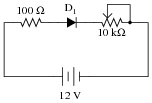
Measuring diode voltage and diode current in this circuit, the student generates the following table of data:
Vdiode Idiode
0.600 V 1.68 mA
0.625 V 2.88 mA
0.650 V 5.00 mA
0.675 V 8.68 mA
0.700 V 14.75 mA
0.725 V 27.25 mA
0.750 V 48.2 mA
This student knows that the behavior of a PN junction follows Shockley’s diode equation, and that the equation may be simplified to the following form:$$I_{diode} = I_S(e^{\frac{V_{diode}}{K}} -1)$$ Where,
K = a constant incorporating both the thermal voltage and the nonideality coefficient
The goal of this experiment is to calculate K and IS, so that the diode’s current may be predicted for any arbitrary value of voltage drop. However, the equation must be simplified a bit before the student can proceed.
At substantial levels of current, the exponential term is very much larger than unity \((e^{\frac{V_{diode}}{K}}>>1)\), so the equation may be simplified as such:
$$I_{diode} \approx I_S(e^{\frac{V_{diode}}{K}})$$ From this equation, determine how the student would calculate K and IS from the data shown in the table. Also, explain how this student may verify the accuracy of these calculated values.
Reveal answerK ≈ 0.04516
IS ≈ 2.869 nA
Hint: this may be a difficult problem to solve if you are unfamiliar with the algebraic technique of dividing one equation by another. Here is the technique shown in general terms:
$$Given: \ \ \ \ \ \ \ \ \ \ \ \ y_1=ax_1 \ \ \ \ \ \ \ \ \ \ \ \ y_2=ax_2$$
$$\frac{y_1}{y_2}=\frac{ax_1}{ax_2}$$
From here, it may be possible to perform simplifications impossible before. I suggest using this technique to solve for K first.
Follow-up question: explain how this student knew it was “safe” to simplify the Shockley diode equation by eliminating the “- 1” term. Is this sort of elimination always permissible? Why or why not?
Notes:The algebraic technique used to solve for K is very useful for certain types of problems.
Discuss the follow-up question with your students. It is important in the realm of technical mathematics to have a good sense of the relative values of equation terms, so that one may “safely” eliminate terms as a simplifying technique without incurring significant errors. In the Shockley diode equation it is easy to show that the exponential term is enormous compared to 1 for the values of Vdiode shown in the table (assuming a typical value for thermal voltage), and so the “- 1” part is very safe to eliminate.
Also discuss the idea of verifying the calculated values of K and IS with your students, to help them cultivate a scientifically critical point of view in their study of electronics.
Incidentally, the data in this table came from a real experiment, set up exactly as shown by the schematic diagram in the question. Care was taken to avoid diode heating by turning the potentiometer to maximum resistance between readings.