Facebook
 Google
 GitHub
 Linkedin
AC Electric Circuits
Polyphase Power Systems
14 questions By Tony R. Kuphaldt
-
Question 7 of 14
This is a schematic diagram of a Y-connected three-phase generator (with the rotor winding shown):
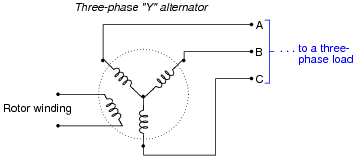
How much AC voltage will appear between any two of the lines (VAB, VBC, or VAC) if each stator coil inside the alternator outputs 277 volts? Draw a phasor diagram showing how the phase (winding) and line voltages relate.
Reveal answerPhase voltage = 277 volts AC (given)
Line voltage = VAB = VBC = VAC = 480 volts AC

Follow-up question #1: what is the ratio between the line and phase voltage magnitudes in a Y-connected three-phase system?
Follow-up question #2: what would happen to the output of this alternator if the rotor winding were to fail open? Bear in mind that the rotor winding is typically energized with DC through a pair of brushes and slip rings from an external source, the current through this winding being used to control voltage output of the alternator’s three-phase “stator” windings.
Notes:Students will quickly discover that √3 is the “magic number” for practically all balanced three-phase circuit calculations!
It should be noted that although the magnitudes of VAB, VBC, and VAC are equal, their phasor angles are most definitely not. Therefore,
VAB = VBC = VAC Scalar values equal VAB ≠ VBC ≠ VAC Phasors unequal -
Question 8 of 14
This is a schematic diagram of a Delta-connected three-phase generator (with the rotor winding shown):
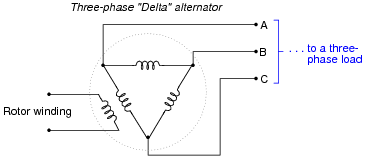
How much AC current will each of the lines (IA, IB, or IC) conduct to a load (not shown) if each stator coil inside the alternator outputs 17 amps of current?
Reveal answerPhase current = 17 amps AC (given)
Line current = IA = IB = IC = 29.4 amps AC
Follow-up question #1: what is the ratio between the line and phase current magnitudes in a Delta-connected three-phase system?
Follow-up question #2: what would happen to the output of this alternator if the rotor winding were to fail open? Bear in mind that the rotor winding is typically energized with DC through a pair of brushes and slip rings from an external source, the current through this winding being used to control voltage output of the alternator’s three-phase “stator” windings.
Notes:Students will quickly discover that √3 is the “magic number” for practically all balanced three-phase circuit calculations!
It should be noted that although the magnitudes of IA, IB, and IC are equal, their phasor angles are most definitely not. Therefore,
IA = IB = IC Scalar values equal IA ≠ IB ≠ IC Phasors unequal -
Question 9 of 14
Suppose the electrical power supplied to a commercial building is labeled as “208/120 volt”. What does this label mean, exactly? Relate this description to a schematic diagram.
Reveal answer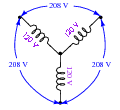
Notes:Many students are confused by this when seeing it for the first time. How is it possible to measure voltage between two points in a circuit and obtain 208 volts, when the two series-connected voltage sources between those two points are 120 volts each? Why isn’t it 240/120 volts instead?
The answer to this question, of course, is phase shift: the answer to most “strange” phenomenon in AC circuits!