Facebook
 Google
 GitHub
 Linkedin
AC Electric Circuits
Polyphase Power Systems
14 questions By Tony R. Kuphaldt
-
Question 10 of 14
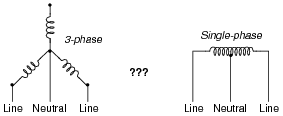
Suppose you are working on the power wiring inside of a home, and are wondering whether or not the home is supplied with 3-phase or single-phase power. You do not have a voltmeter available to measure voltage, but you do have plenty of light bulbs, switches, wires, and other standard residential wiring components available for use.
The two possibilities for this home’s power source are shown here, the coils representing secondary windings of the utility power transformer:
An experienced electrician suggests you build the following circuit to test whether or not the home’s power is supplied by a 3-phase source or a single-phase source:
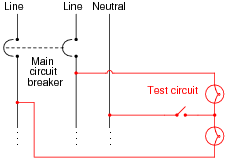
The electrician tells you to open and close the switch, and observe the brightness of the light bulbs. This will indicate whether or not the system is 3-phase.
Explain how this circuit works. What sort of light bulb behavior would indicate a 3-phase source? What sort of light bulb behavior would indicate a single-phase source?
Reveal answerOn a single-phase system, there should be no change in light bulb brightness as the switch is opened and closed. On a three-phase system, there will be a change in brightness between the two different switch states (I’ll let you figure out which switch state makes the light bulbs glow brighter!).
Notes:The subject of this question is closely related to the subject of “single-phasing” a polyphase load as the result of a line conductor opening. In this case it is the neutral conductor we are intentionally opening, but the results are similar.
-
Question 11 of 14
This Delta-connected three-phase power source provides three different voltage levels: 120 V, 208 V, and 240 V. Determine which points of connection provide these voltages:

Reveal answerVAB = VBC = VAC = 240 volts
VAG = VCG = 120 volts
VBG = 208 volts
Notes:Despite the fact that this connection scheme is quite common in industry, I have found little reference to it in textbooks. The equilateral layout of the windings in this diagram facilitates graphical (phasor) analysis of the voltages, providing students with the opportunity to exercise their knowledge of trigonometry.
-
Question 12 of 14
The line voltage to this three-phase load is 480 volts. How much power (total) is dissipated by the load? How much current is there in each line supplying the load?
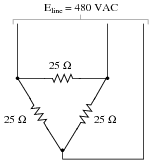
One more question: write an equation for calculating power in a balanced, three-phase circuit, given line voltage and line current only.
Reveal answerPtotal = 27.648 kW
Iline = 33.255 A
I’ll let you derive your own equation for power calculation. Be ready to show your work!
Notes:Now, students will surely be able to find a power equation from textbooks, but the purpose of this question is to have them derive it themselves. In a single-phase, resistive AC circuit, power is given by the equation P = I E, just as in DC circuits. However, if you multiply the line voltage by line current, you do not get the correct answer of 27.648 kW. So, obviously, the equation of P = I E will require some modification for calculating total three-phase power. However, this modification is not complicated to perform.