Facebook
 Google
 GitHub
 Linkedin
Discrete Semiconductor Devices and Circuits
Rectifier Circuits
17 questions By Tony R. Kuphaldt
-
Question 13 of 17
Suppose you need to build a full-wave bridge rectifier with a current rating of 2.5 amps, but only have model 1N4001 diodes to build it with. Draw a schematic diagram of the circuit, showing how multiple 1N4001 diodes could be connected together to accomplish this:

Reveal answer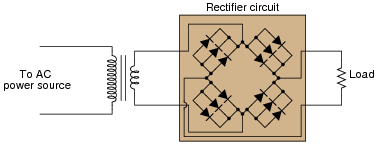
Follow-up question: while this circuit should work (in theory), in practice one or more of the diodes will fail prematurely due to overheating. The fix for this problem is to connect “swamping” resistors in series with the diodes like this:
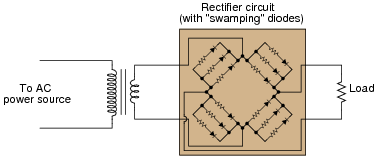
Explain why these resistors are necessary to ensure long diode life.
Notes:The answer to this question should not be much of a challenge to your students, although the follow-up question is a bit challenging. Ask your students what purpose the swamping resistors serve in this circuit. What do we know about current through the diodes if one or more of them will fail due to overheating without the swamping resistors?
What value of resistor would your students recommend for this application? What factors influence their decision regarding the resistance value?
-
Question 14 of 17
Predict how all component voltages and currents in this circuit will be affected as a result of the following faults. Consider each fault independently (i.e. one at a time, no multiple faults):
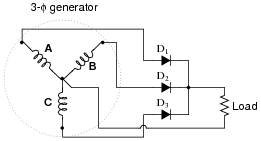
- Diode D1 fails open:
- Generator winding C fails open:
- Center connection joining generator windings fails open:
For each of these conditions, explain why the resulting effects will occur.
Reveal answer- Diode D1 fails open: Load receives 2-pulse rectification instead of 3-pulse, increased voltage across D1.
- Generator winding C fails open: Load receives 2-pulse rectification instead of 3-pulse, no current through D3.
- Center connection joining generator windings fails open: No voltage across any diode or across load, no current through any diode or through load.
Notes:The purpose of this question is to approach the domain of circuit troubleshooting from a perspective of knowing what the fault is, rather than only knowing what the symptoms are. Although this is not necessarily a realistic perspective, it helps students build the foundational knowledge necessary to diagnose a faulted circuit from empirical data. Questions such as this should be followed (eventually) by other questions asking students to identify likely faults based on measurements.
-
Question 15 of 17
Predict how all component voltages and currents in this circuit will be affected as a result of the following faults. Consider each fault independently (i.e. one at a time, no multiple faults):
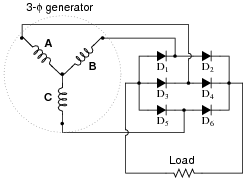
- Diode D3 fails open:
- Generator winding C fails open:
- Center connection joining generator windings fails open:
For each of these conditions, explain why the resulting effects will occur.
Reveal answer- Diode D3 fails open: Load receives 5-pulse rectification instead of 6-pulse, increased voltage across D3.
- Generator winding C fails open: Load receives 2-pulse rectification instead of 6-pulse, no current through D5 or D6.
- Center connection joining generator windings fails open: No voltage across any diode or across load, no current through any diode or through load.
Notes:The purpose of this question is to approach the domain of circuit troubleshooting from a perspective of knowing what the fault is, rather than only knowing what the symptoms are. Although this is not necessarily a realistic perspective, it helps students build the foundational knowledge necessary to diagnose a faulted circuit from empirical data. Questions such as this should be followed (eventually) by other questions asking students to identify likely faults based on measurements.