Facebook
 Google
 GitHub
 Linkedin
Discrete Semiconductor Devices and Circuits
Zener Diodes
23 questions By Tony R. Kuphaldt
-
Question 13 of 23
Calculate the current through the zener diode for the given values of input (source) voltage in this circuit:
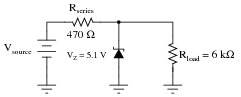
- Vsource = 25 V ; Izener =
- Vsource = 20 V ; Izener =
- Vsource = 15 V ; Izener =
- Vsource = 10 V ; Izener =
- Vsource = 5 V ; Izener =
Do you see any relationship between source voltage and zener diode current? If so, explain what that relationship is.
Reveal answerAs the source voltage decreases, zener diode current also decreases:
- Vsource = 25 V ; Izener = 41.49 mA
- Vsource = 20 V ; Izener = 30.85 mA
- Vsource = 15 V ; Izener = 20.21 mA
- Vsource = 10 V ; Izener = 9.58 mA
- Vsource = 5 V ; Izener = 0 mA
Follow-up question: what value of source voltage input will result in zero current through the zener diode (while still maintaining an output voltage of 5.1 volts)?
Notes:This exercise in current calculation is supposed to get students to realize the inverse relationship between input voltage and zener current: that the zener diode regulates voltage by acting as a parasitic load of varying proportion. Simply put, the diode loads down the circuit as much as needed to maintain a stable voltage at the load terminals.
It should be noted that the calculated answers shown here will not precisely match a real zener diode circuit, due to the fact that zener diodes tend to gradually taper off in current as the applied voltage nears the zener voltage rating rather than current sharply dropping to zero as a simpler model would predict.
The follow-up question is very important. All zener diode regulator circuits have a minimum input voltage value that must be adhered to, lest the output voltage droop below the regulation point. Discuss with your students how the zener diode’s “loading” behavior explains the need for a certain minimum source voltage.
-
Question 14 of 23
Qualitatively determine what will happen to the series resistor current and the zener diode current in this voltage regulator circuit if the load current suddenly decreases. Assume that the zener diode’s behavior is ideal; i.e. its voltage drop holds absolutely constant throughout its operating range.

IRseries = (increase, decrease, or unchanged?)
Izener = (increase, decrease, or unchanged?)
Reveal answerIf the load current decreases, Izener will increase and IRseries will remain unchanged.
Challenge question: what do you think will happen with a real zener diode, where its voltage drop does change slightly with changes in current?
Notes:A conceptual understanding of zener diode regulator circuits is important, perhaps even more important than a quantitative understanding. Your students will need to understand what happens to the different variables in such a circuit when another parameter changes, in order to understand how these circuits will dynamically react to changing load or source conditions.
-
Question 15 of 23
Qualitatively determine what will happen to the load current and the zener diode current in this voltage regulator circuit if the source voltage suddenly increases. Assume that the zener diode’s behavior is ideal; i.e. its voltage drop holds absolutely constant throughout its operating range.

Iload = (increase, decrease, or unchanged?)
Izener = (increase, decrease, or unchanged?)
Reveal answerIf the source voltage increases, Izener will increase and Iload will remain unchanged.
Challenge question: what do you think will happen with a real zener diode, where its voltage drop does change slightly with changes in current?
Notes:A conceptual understanding of zener diode regulator circuits is important, perhaps even more important than a quantitative understanding. Your students will need to understand what happens to the different variables in such a circuit when another parameter changes, in order to understand how these circuits will dynamically react to changing load or source conditions.