Facebook
 Google
 GitHub
 Linkedin
Discrete Semiconductor Devices and Circuits
Zener Diodes
23 questions By Tony R. Kuphaldt
-
Question 4 of 23
Not all “zener” diodes break down in the exact same manner. Some operate on the principle of zener breakdown, while others operate on the principle of avalanche breakdown. How do the temperature coefficients of these two zener diode types compare, and how are you able to discern whether a zener diode uses one principle or the other just from its breakdown voltage rating?
Correspondingly, is there a way we could determine the type of breakdown action from experimental measurements on a zener diode? Explain how such an experiment might be set up.
Reveal answerLow-voltage zener diodes have negative temperature coefficients, because they exploit the zener effect. High-voltage zener diodes have positive temperature coefficients, because they exploit the avalanche effect. I’ll let you research how to tell the difference between zener diodes employing each phenomenon on your own!
Challenge question: explain the difference between the “zener” and “avalanche” effects, in terms of charge carrier action.
Notes:Regular “rectifying” diodes also have temperature coefficients. Ask your students to identify whether the temperature coefficient for a rectifying diode is typically positive or negative, and what this actually means. It is very easy to experimentally verify this, so you may want to ask your students to demonstrate how to determine the sign of a rectifying diode’s temperature coefficient as a prelude to reviewing the experimental portion of the original question.
Ask your students to identify the typical voltage values associated with both types of breakdown effect. This will quickly reveal which students did their research for this question, as opposed to those who merely read the answer given here!
-
Question 5 of 23
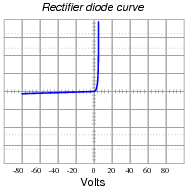
Explain how the characteristic curve of a 24 volt zener diode (as plotted by a curve tracer) differs from that of a normal rectifying diode, shown here:
Reveal answer
Notes:The purpose of this question is to cause students to think about what a characteristic curve means, in the context of diode comparisons. The breakdown voltage of a zener diode is typically so low compared to that of a normal rectifying diode that this region may be easily shown on the curve tracer screen.
-
Question 6 of 23
Suppose you had the boring job of manually maintaining the output voltage of a DC generator constant. Your one and only control over voltage is the setting of a rheostat:
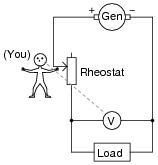
What would you have to do to maintain the load voltage constant if the load resistance changed so as to draw more current? Being that your only control over load voltage is the adjustment of a variable resistance in series with the generator, what does this imply about the generator’s output voltage (directly across the generator terminals), compared to the target load voltage?
Reveal answerIn order to increase the load voltage, you must decrease the resistance of the rheostat. In order for this scheme to work, the generator’s voltage must be greater than the target load voltage.
Note: this general voltage control scheme is known as series regulation, where a series resistance is varied to control voltage to a load.
Notes:The direction of rheostat adjustment should be obvious, as is the fact that the generator’s voltage must be at least as high as the intended (target) load voltage. However, it may not be obvious to all that the generator’s voltage cannot merely be equal to the intended load voltage.
To illustrate the necessity of this, ask your students how the system would work if the generator’s output voltage was exactly equal to the intended load voltage. Emphasize the fact that the generator is not perfect: it has its own internal resistance, the value of which cannot be changed by you. What position would the rheostat have to be in, under these conditions, in order to maintain target voltage at the load? Could the target voltage be maintained at all?