Facebook
 Google
 GitHub
 Linkedin
AC Electric Circuits
AC phase
24 questions By Tony R. Kuphaldt
-
Question 7 of 24
What does it mean to add two or more phasors together, in a geometric sense? How would one draw a phasor diagram showing the following two phasors added together?

Reveal answerHere are two ways of showing the same addition:
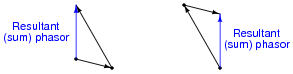
Follow-up question: how would you verbally explain the process of phasor addition? If you were to describe to someone else how to add phasors together, what would you tell them?
Notes:Discuss with your students that phasors may also be subtracted, multiplied, and divided. Subtraction is not too difficult to visualize, but addition and multiplication defies geometric understanding for many.
-
Question 8 of 24
Determine the sum of these two phasors, and draw a phasor diagram showing their geometric addition:
(4 ∠ 0o) (3 ∠ 90o)
How might a phasor arithmetic problem such as this relate to an AC circuit?
Reveal answer(4 ∠ 0o) (3 ∠ 90o) = (5 ∠ 36.87o)
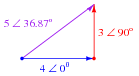
Notes:It is very helpful in a question such as this to graphically depict the phasors. Have one of your students draw a phasor diagram on the whiteboard for the whole class to observe and discuss.
The relation of this arithmetic problem to an AC circuit is a very important one for students to grasp. It is one thing for students to be able to mathematically manipulate and combine phasors, but quite another for them to smoothly transition between a phasor operation and comprehension of voltages and/or currents in an AC circuit. Ask your students to describe what the magnitude of a phasor means (in this example, the number 5), if that phasor represents an AC voltage. Ask your students to describe what the angle of an AC voltage phasor means, as well (in this case, 36.87o), for an AC voltage.
-
Question 9 of 24
Phasors may be symbolically described in two different ways: polar notation and rectangular notation. Explain what each of these notations means, and why either one may adequately describe a phasor.
Reveal answerPolar notation describes a phasor in terms of magnitude (length) and angle:

Rectangular notation describes a phasor in terms of horizontal and vertical displacement:

Follow-up question: why do we need the letter j in rectangular notation? What purpose does it serve, and what does it mean?
Notes:When discussing the meaning of j, it might be good to explain what imaginary numbers are. Whether or not you choose to do this depends on the mathematical aptitude and background of your students.