Facebook
 Google
 GitHub
 Linkedin
AC Electric Circuits
AC phase
24 questions By Tony R. Kuphaldt
-
Question 22 of 24
Before two or more operating alternators (AC generators) may be electrically coupled, they must be brought into synchronization with each other. If two alternators are out of “sync” (or out of phase) with each other, the result will be a large fault current when the disconnect switch is closed.
A simple and effective means of checking for “sync” prior to closing the disconnect switch for an alternator is to have light bulbs connected in parallel with the disconnect switch contacts, like this:

What should the alternator operator look for before closing the alternator switch? Do bright lights indicate a condition of being “in-phase” with the bus, or do dim lights indicate this? What does the operator have to do in order to bring an alternator into “phase” with the bus voltage?
Also, describe what the light bulbs would do if the two alternators were spinning at slightly different speeds.
Reveal answerDim lights indicate a condition of being “in-phase” with the bus. If the two alternators are spinning at slightly different speeds, there will be a heterodyne effect to the light bulbs’ brightness: alternately growing brighter, then dimmer, then brighter again.
Notes:Proper synchronization of alternators with bus voltage is a task that used to be performed exclusively by human operators, but may now be accomplished by automatic controls. It is still important, though, for students of electricity to understand the principles involved in alternator synchronization, and the simple light bulb technique of sync-indication is an excellent means of clarifying the concept.
Discuss with your students the means of bringing an alternator into phase with an AC bus. If the light bulbs are glowing brightly, what should the operator do to make them dim?
It might also be a good idea to discuss with your students what happens once two synchronized alternators become electrically coupled: the two machines become “locked” together as though they were mechanically coupled, thus maintaining synchronization from that point onward.
-
Question 23 of 24
Suppose a power plant operator was about to bring this alternator on-line (connect it to the AC bus), and happened to notice that neither one of the synchronizing lights was lit at all. Thinking this to be unusual, the operator calls you to determine if something is wrong with the system. Describe what you would do to troubleshoot this system.

Reveal answerBefore you proceed with troubleshooting steps, first try to determine if there is anything wrong with this system at all. Could it be that the operator is just overly cautious, or is their caution justified?
Notes:There may be some students who suggest there is nothing wrong at all with the system. Indeed, since dim (or dark) lights normally indicate synchronization, would not the presence of two dim lights indicate that perfect synchronization had already been achieved? Discuss the likelihood of this scenario with your students, that two independent alternators could be maintaining perfect synchronization without being coupled together.
In regard to troubleshooting, this scenario has great potential for group discussion. Despite there being a simple, single, probable condition that could cause this problem, there are several possible component failures that could have created the condition. Different students will undoubtedly have different methods of approaching the problem. Let each one share their views, and discuss together what would be the best approach.
-
Question 24 of 24
Shown here are two sine waves of equal frequency, superimposed on the same graph:
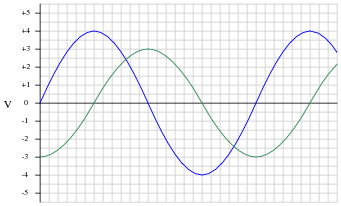
As accurately as possible, determine the amount of phase shift between the two waves, based on the divisions shown on the graph.
Also, plot a third sine wave that is the sum of the two sine waves shown. Again, do this as accurately as possible, based on the divisions shown on the graph. To give an example of how you might do this, observe the following illustration:
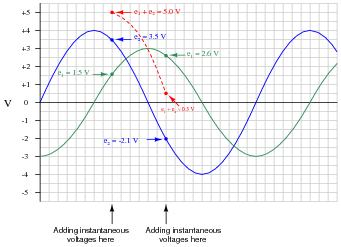
What is the peak value of the resultant (sum) sine-wave? How does this compare with the peak values of the two original sine waves?
Reveal answerThe two (original) sine waves are 90o out of phase, one with a peak value of 4 volts, and the other with a peak value of 3 volts.
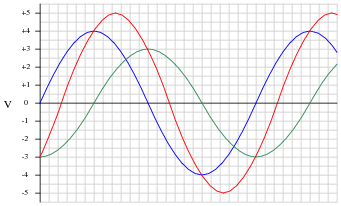
Together, they add to make a third sine wave with a peak value of 5 volts.
Follow-up question: how is it possible that the sum of 3 and 4 makes 5? Hint: you’ve probably seen something like this when studying trigonometry!
Notes:Though it may seem a laborious exercise at first, the point of this question is for students to realize that the sum of two equal-frequency sine waves is another sine wave. The peak values of 3 and 4, together with the phase-shift of 90o, was no coincidence on my part when I wrote this question. Where else in mathematics have students seen an example of the quantities 3 and 4 being combined (at 90 degrees) to make a quantity of 5?