Facebook
 Google
 GitHub
 Linkedin
AC Electric Circuits
Autotransformers
12 questions By Tony R. Kuphaldt
-
Question 4 of 12
Connect the windings of this step-down transformer so that it “boosts” the voltage going to the load by 12 volts:

Reveal answer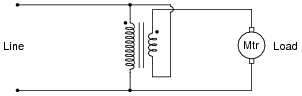
Notes:Phase markings (the dots near the end of each winding) are very important when deciding which way to connect transformer windings! Some students may find it helpful to use DC polarity markings ( and -) in addition to dots, to determine whether voltages will be in-phase (boosting) or out-of-phase (bucking).
-
Question 5 of 12
Connect the windings of this step-down transformer so that it “bucks” the voltage going to the light bulb by 12 volts:
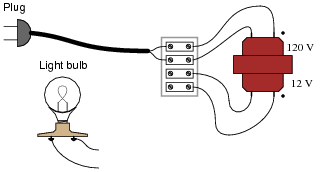
Reveal answer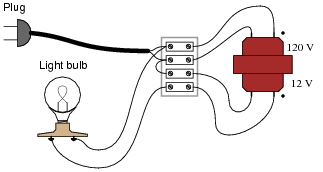
Notes:Phase markings (the dots near the end of each winding) are very important when deciding which way to connect transformer windings! Some students may find it helpful to use DC polarity markings ( and -) in addition to dots, to determine whether voltages will be in-phase (boosting) or out-of-phase (bucking).
-
Question 6 of 12
How could we possibly determine the phasing of the windings in this step-down transformer (120 VAC, 60 Hz primary) so we would know how to connect them for either boosting or bucking service?

Reveal answerConnect one of the secondary wires to one of the primary wires. Then, measure voltage with a voltmeter between the other two secondary and primary winding wires (the two that are not electrically common). The voltage reading obtained by this test will indicate the phasing.
Notes:Note that the answer given to this question leaves the particular details of how to interpret the voltmeter readings unanswered. Challenge your students to figure this out on their own.
Given that autotransformer connections are so practical, it is important for students to know how to test a transformer to see how its (unmarked) windings are phased.