Facebook
 Google
 GitHub
 Linkedin
AC Electric Circuits
Autotransformers
12 questions By Tony R. Kuphaldt
-
Question 7 of 12
Suppose you had an audio impedance-matching transformer (1000 Ω to 8 Ω), and you wished to know the phase relationships of the windings. Unfortunately, the only test equipment you have is an analog DC voltmeter and a 9-volt battery. Explain how you would use these two devices to test winding “polarity.”

Note: you may disregard the center-tap of the 1000 Ω primary winding.
Reveal answerI won’t give you the answer directly here, but I will give you a hint: although transformers cannot function on continuous DC, they will respond to pulses of current in a given direction! In other words, you can use intermittent DC from the 9-volt battery to test the windings.
Challenge question: calculate the turns ratio of this transformer, based on the ratio of impedances.
Notes:Note that the answer given to this question leaves the particular details of how to interpret the voltmeter readings unanswered. Challenge your students to figure this out on their own.
Audio matching transformers are easy to obtain, so I encourage you have your students try this as a lab exercise.
-
Question 8 of 12
It should be obvious that the load voltage in this resistive voltage divider circuit will be less than 30 volts AC (RMS):

Likewise, it should be apparent that the load voltage in this inductive voltage divider circuit will be less than 30 volts AC (RMS):

From this brief analysis it would appear these two voltage divider circuits are equivalent to one another. However, there is a very important difference in terms of current: load versus supply. Estimate the load and source currents in each of these divider circuits, and comment on the difference(s) between the two.
Reveal answerIn the resistive circuit, the load current will be less than the supply current. In the inductive (autotransformer) circuit, though, the load current will exceed the source current!
Notes:Ask your students to determine which voltage divider circuit will be more energy-efficient.
-
Question 9 of 12
A popular piece of electrical bench test equipment is the Variac. Explain what a Variac is, how it works, and what applications it might be used for.
Reveal answerHere is the schematic diagram for a Variac:
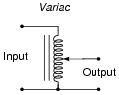
I’ll let you research the answers to the other parts of this question!
Notes:If you have a Variac in your lab, be sure to bring it to class for the discussion period so students may directly see what one looks like. If time permits, let your students experiment with it during discussion, to test their hypotheses about its function.