Facebook
 Google
 GitHub
 Linkedin
Discrete Semiconductor Devices and Circuits
Bipolar Junction Transistors in Active Mode
23 questions By Tony R. Kuphaldt
-
Question 4 of 23
Load lines are useful tools for analyzing transistor amplifier circuits, but they may be applied to other types of circuits as well. Take for instance this diode-resistor circuit:

The diode’s characteristic curve is already plotted on the following graph. Your task is to plot the load line for the circuit on the same graph, and note where the two lines intersect:
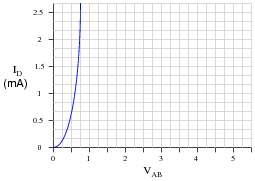
What is the practical significance of these two plots’ intersection?
Reveal answerThe two lines intersect at a current of approximately 1.72 mA:

Follow-up question: explain why the use of a load line greatly simplifies the determination of circuit current in such a diode-resistor circuit.
Challenge question: suppose the resistor value were increased from 2.5 kΩ to 10 kΩ. What difference would this make in the load line plot, and in the intersection point between the two plots?
Notes:While this approach to circuit analysis may seem silly - using load lines to calculate the current in a diode-resistor circuit - it demonstrates the principle of load lines in a context that should be obvious to students at this point in their study. Discuss with your students how the load line is obtained for this circuit, and why it is straight while the diode’s characteristic curve is not.
Also, discuss the significance of the two line intersecting. Mathematically, what does the intersection of two graphs mean? What do the coordinate values of the intersection point represent in a system of simultaneous functions? How does this principle relate to an electronic circuit?
-
Question 5 of 23
A very important measure of a transistor’s behavior is its characteristic curves, a set of graphs showing collector current over a wide range of collector-emitter voltage drops, for a given amount of base current. The following plot is a typical curve for a bipolar transistor with a fixed value of base current:
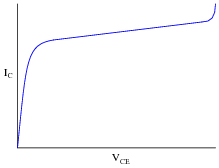
A “test circuit” for collecting data to make this graph looks like this:

Identify three different regions on this graph: saturation, active, and breakdown, and explain what each of these terms mean. Also, identify which part of this curve the transistor acts most like a current-regulating device.
Reveal answer
The transistor’s best current-regulation behavior occurs in its “active” region.
Follow-up question: what might the characteristic curves look like for a transistor that is failed shorted between its collector and emitter terminals? What about the curves for a transistor that is failed open?
Notes:Ask your students what a perfect current-regulating curve would look like. How does this perfect curve compare with the characteristic curve shown in this question for a typical transistor?
A word of caution is in order: I do not recommend that a test circuit such as the one shown in the question be built for collecting curve data. If the transistor dissipates power for any substantial amount of time, it will heat up and its curves will change dramatically. Real transistor curves are generated by a piece of test equipment called a “curve tracer,” which sweeps the collector-emitter voltage and steps the base current very rapidly (fast enough to “paint” all curves on an oscilloscope screen before the phosphor stops glowing).
-
Question 6 of 23
If a transistor is subjected to several different base currents, and the collector-emitter voltage (VCE) ßwept” through the full range for each of these base current values, data for an entire “family” of characteristic curves may be obtained and graphed:
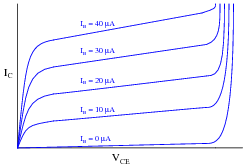
What do these characteristic curves indicate about the base current’s control over collector current? How are the two currents related?
Reveal answerThe collector current is (for the most part) directly proportional to base current while in the “active” region.
Notes:Ask your students what the characteristic curves would look like for a perfect transistor: one that was a perfect regulator of collector current over the full range of collector-emitter voltage.