Facebook
 Google
 GitHub
 Linkedin
Discrete Semiconductor Devices and Circuits
Bipolar Junction Transistors in Active Mode
23 questions By Tony R. Kuphaldt
-
Question 13 of 23
Explain what it means for a transistor to operate in its “active” mode (as opposed to cutoff, saturation, or breakdown).
Reveal answerIn the active mode, a transistor “throttles” current somewhere between being fully off and fully on.
Notes:Help your students contrast active transistor operation with what they know of transistors as switching elements (either saturated or cut off). Ask them to explain what is unique about transistor behavior in the active region that is not exhibited in any other region (i.e. the transistor’s behavior with regard to collector current and collector-emitter voltage).
-
Question 14 of 23
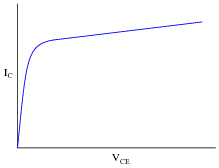
We know that graphs are nothing more than collections of individual points representing correlated data in a system. Here is a plot of a transistor’s characteristic curve (for a single value of base current):
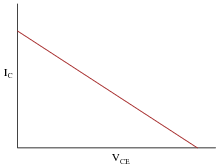
And here is a plot of the “load line” for a transistor amplifier circuit:
For each of these graphs, pick a single point along the curve (or line) and describe what that single point represents, in real-life terms. What does any single point of data along either of these graphs mean in a transistor circuit?
If a transistor’s characteristic curve is superimposed with a load line on the same graph, what is the significance of those two plots’ intersection?
Reveal answerFor a transistor’s characteristic curve, one point of data represents the amount of current that will go through the collector terminal for a given amount of base current, and a given amount of collector-emitter voltage drop.
For a load line, one point of data represents the amount of collector-emitter voltage available to the transistor for a given amount of collector current.
The intersection of a characteristic curve and a load line represents the one collector current (and corresponding VCE voltage drop) that will “satisfy” all components’ conditions.
Notes:Discuss this question thoroughly with your students. So many students of electronics learn to plot load lines for amplifier circuits without ever really understanding why they must do so. Load line plots are very useful tools in amplifier circuit analysis, but the meaning of each curve/line must be well understood before it becomes useful as an instrument of understanding.
Ask your students which of the two types of graphs (characteristic curves, or load lines) represents a component’s natural, or “free”, behavior, and which one represents the bounded conditions within a particular circuit.
-
Question 15 of 23
Describe what a load line is, at it appears superimposed on this graph of characteristic transistor curves:
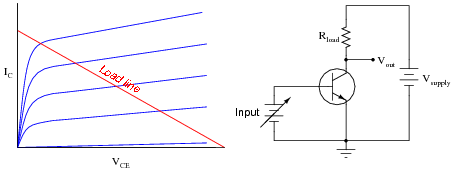
What exactly does the load line represent in the circuit?
Reveal answerA load line is a plot showing the amount of collector-emitter voltage available to the transistor (VCE) for any given collector current:

Follow-up question: why are load lines always straight, and not bent as the transistor characteristic curves are? What is it that ensures load line plots will always be linear functions?
Notes:It is very important for students to grasp the ontological nature of load lines (i.e. what they are) if they are to use them frequently in transistor circuit analysis. This, sadly, is something often not grasped by students when they begin to study transistor circuits, and I place the blame squarely on textbooks (and instructors) who don’t spend enough time introducing the concept.
My favorite way of teaching students about load lines is to have them plot load lines for non-transistor circuits, such as voltage dividers (with one of two resistors labeled as the “load,” and the other resistor made variable) and diode-resistor circuits.