
 Facebook
 Google
 GitHub
 Linkedin
Discrete Semiconductor Devices and Circuits
Bipolar Junction Transistors in Active Mode
23 questions By Tony R. Kuphaldt
-
Question 19 of 23
An important parameter of transistor amplifier circuits is the Q point, or quiescent operating point. The “Q point” of a transistor amplifier circuit will be a single point somewhere along its load line.
Describe what the “Q point” actually means for a transistor amplifier circuit, and how its value may be altered.
Reveal answerThe “Q point” for a transistor amplifier circuit is the point along its operating region in a “quiescent” condition: when there is no input signal being amplified.
Notes:Q points are very important in the design process of transistor amplifiers, but again students often seem to fail to grasp the actual meaning of the concept. Ask your students to explain how the load line formed by the load resistance, and characteristic curves of the transistor, describe all the possible operating conditions of collector current and VCE for that amplifier circuit. Then discuss how the status of that circuit is defined at any single point in time along those graphs (by a line, a curve, or a point?).
-
Question 20 of 23
The following graph is a family of characteristic curves for a particular transistor:
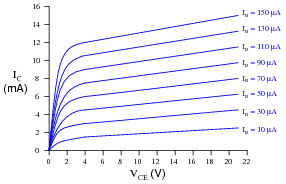
Draw the load line and identify the Q-point on that load line for a common-collector amplifier circuit using this transistor:

Reveal answer
Follow-up question: the position of this circuit’s Q-point is approximately mid-way along the load line. Would you say this is indicative of an amplifier biased for Class A operation, or for some other class of operation? Explain your answer.
Notes:The purpose of this question is to get students to relate their existing knowledge of common-collector circuit DC analysis to the concept of load lines and Q-points. Ask your students to share their analysis techniques with the whole class.
-
Question 21 of 23
The following graph is a family of characteristic curves for a particular transistor:
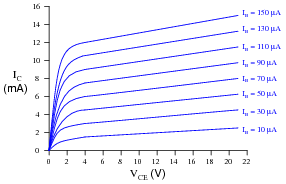
Draw the load line and identify the Q-point on that load line for a common-emitter amplifier circuit using this transistor:

Reveal answer
Follow-up question: determine what would happen to the Q-point if resistor R2 (the 2.2 kΩ biasing resistor) were to fail open.
Notes:The purpose of this question is to get students to relate their existing knowledge of common-emitter circuit DC analysis to the concept of load lines and Q-points. Ask your students to share their analysis techniques with the whole class.


