Facebook
 Google
 GitHub
 Linkedin
Discrete Semiconductor Devices and Circuits
Bipolar Junction Transistors in Active Mode
23 questions By Tony R. Kuphaldt
-
Question 22 of 23
The following graph is a family of characteristic curves for a particular transistor:
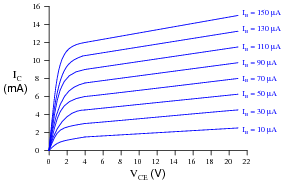
Superimpose on that graph a load line for the following common-emitter amplifier circuit using the same transistor:

Also determine some bias resistor values (R1 and R2) that will cause the Q-point to rest approximately mid-way on the load line.
R1 = R2 =
Reveal answer
There are several pairs of resistor values that will work adequately to position the Q-point at the center of the load line. I leave this an an exercise for you to work through and discuss with your classmates!
Follow-up question: determine what would happen to the Q-point if resistor R2 (the 2.2 kΩ biasing resistor) were to fail open.
Notes:This is a very practical question, as technicians and engineers alike need to choose proper biasing so their amplifier circuits will operate in the intended class (A, in this case). There is more than one proper answer for the resistor values, so be sure to have your students share their solutions with the whole class so that many options may be explored.
-
Question 23 of 23
Find one or two real bipolar junction transistors and bring them with you to class for discussion. Identify as much information as you can about your transistors prior to discussion:
- Terminal identification (which terminal is base, emitter, collector)
- Continuous power rating
- Typical β
Reveal answerIf possible, find a manufacturer’s datasheet for your components (or at least a datasheet for a similar component) to discuss with your classmates. Be prepared to prove the terminal identifications of your transistors in class, by using a multimeter!
Notes:The purpose of this question is to get students to kinesthetically interact with the subject matter. It may seem silly to have students engage in a “show and tell” exercise, but I have found that activities such as this greatly help some students. For those learners who are kinesthetic in nature, it is a great help to actually touch real components while they’re learning about their function. Of course, this question also provides an excellent opportunity for them to practice interpreting component markings, use a multimeter, access datasheets, etc.