Facebook
 Google
 GitHub
 Linkedin
Discrete Semiconductor Devices and Circuits
Bipolar Transistor Biasing Circuits
21 questions By Tony R. Kuphaldt
-
Question 19 of 21
Describe how proper biasing is accomplished in this headphone amplifier circuit (suitable for amplifying the audio output of a small radio):
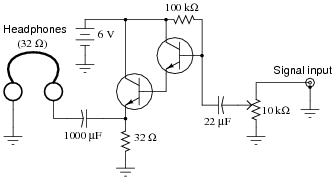
Also, describe the functions of the 10 kΩ potentiometer and the 22 μF capacitor.
Reveal answerBiasing is accomplished through the 100 kΩ resistor. The 10 kΩ potentiometer is the volume control, and the 22 μF capacitor serves to “couple” the input signal to the transistor’s base, while blocking any DC bias voltage from being “fed back” to the audio signal source.
Challenge question: there is a name used to describe the dual-transistor configuration used in this circuit, where a pair of PNP or NPN transistors is cascaded, with the emitter of one going to the base of the other. What is this name, and what advantage does this configuration provide over a single transistor?
Notes:This circuit is simple enough to assemble and test in an hour or two, on a solderless breadboard. It would make a great lab experiment, and can be used by the students outside of class!
-
Question 20 of 21
The following circuit is a three-channel audio mixer circuit, used to blend and amplify three different audio signals (coming from microphones or other signal sources):

Suppose we measured a 9 kHz sinusoidal voltage of 0.5 volts (peak) at point Ä” in the diagram, using an oscilloscope. Determine the voltage at point “B” in the circuit, after this AC signal voltage “passes through” the voltage divider biasing network.
The voltage at point “B” will be a mix of AC and DC, so be sure to express both quantities! Ignore any “loading” effects of the transistor’s base current on the voltage divider.
Reveal answerVB = 1.318 VDC 0.5 VAC (peak)
Notes:Ask your students what purpose the 47 μF capacitor serves. Since its presence does not noticeably attenuate the AC signal at point “A” (the whole 0.5 volts AC getting to point B), why not just replace it with a straight piece of wire?
-
Question 21 of 21
Explain what is meant by the phrase, “Class-A amplifier operation.” What does it mean for a particular amplifier circuit to operate in “Class-A” mode?
Reveal answer“Class-A” amplifier operation means that the final (power) transistor duplicates the entire waveshape of the input signal, and not just a part of it.
Notes:Of course, the natural question following this one is, “What other classes of operation are there?” This would be an excellent time to preview Class-B (push-pull) and Class-C operations if time permits.