Facebook
 Google
 GitHub
 Linkedin
Discrete Semiconductor Devices and Circuits
Differential Transistor Amplifiers
19 questions By Tony R. Kuphaldt
-
Question 10 of 19
Write an approximate equation describing the differential voltage gain for a differential pair circuit such as this, in terms of the component values:

Reveal answer$$A_{V(diff)} = \frac{R_C}{2r'_e}$$
Follow-up question: what component value(s) should be altered to maximize differential voltage gain in a differential pair circuit, and why?
Notes:The purpose of this question is to have students apply the Superposition theorem to combine two voltage gain equations into a single differential voltage gain equation.
-
Question 11 of 19
Describe what happens to each of the output voltages (Vout1 and Vout2) as the input voltage (Vin) decreases:
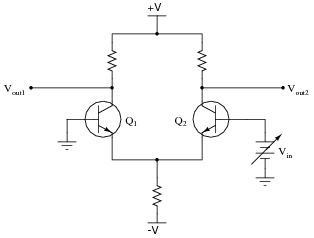
Reveal answerVout1 will decrease (become more negative), while Vout2 will increase (become more positive).
Notes:With four terminals to connect to the outside world, this circuit is a differential-input, differential-output amplifier.
-
Question 12 of 19
Suppose this differential-pair circuit was perfectly balanced. In this condition, how much voltage would be expected between the two transistors’ collector terminals?
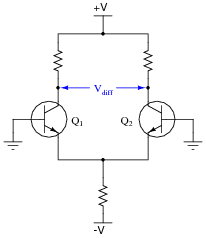
What would happen to this differential voltage (Vdiff) if transistor Q2 were to increase in temperature, while transistor Q1 remained at the same temperature? Explain your answer.
Reveal answerIn a balanced condition, Vdiff = 0 volts. If Q2 heats up and Q1 does not, a differential voltage will develop between the two collector terminals, with Q1’s collector being the positive and Q2’s collector being the negative:

Follow-up question: what does this phenomenon mean with regard to the stability of differential-pair transistor circuits under different operating conditions? What might be a good way to maximize circuit stability over a wide range of operating temperatures?
Notes:Fundamentally, the issue in this question is what happens to a transistor when it heats up, but the electrical supply (power and input signal) parameters do not change. Ask your students to relate this phenomenon to the behavior of other PN junction devices, such as diodes.