Facebook
 Google
 GitHub
 Linkedin
Discrete Semiconductor Devices and Circuits
Differential Transistor Amplifiers
19 questions By Tony R. Kuphaldt
-
Question 4 of 19
Identify the type of transistor amplifier this is (common-collector, common-emitter, or common-base), and identify whether it is inverting or noninverting.

Also, explain how to derive the voltage gain equation for this amplifier:
$$A_V= \frac{R_E}{R_E+r'_e}$$
Reveal answerThis is a common-collector amplifier circuit, and it is noninverting. Here is a schematic hint for explaining why the voltage gain formula is as it is. Note that the transistor is modeled here as a resistance and a controlled current source:

Follow-up question: the voltage gain equation for this type of transistor amplifier is usually shown in a simpler form that what I provided at the end of the question. Write this simpler form, and explain why it is approximately true.
Notes:In discussion with your students, analyze the response of this single-transistor amplifier circuit for a variety of input voltages. In other words, perform a thought experiment to re-familiarize them with the behavior of this transistor amplifier configuration. Plot the input and output voltages, if necessary, on a graph. Discuss what the term “noninverting” means in this context.
-
Question 5 of 19
Identify the type of transistor amplifier this is (common-collector, common-emitter, or common-base), and identify whether it is inverting or noninverting.

Also, explain how to derive the voltage gain equation for this amplifier:
$$A_V= \frac{R_C}{r'_e}$$
Reveal answerThis is a common-base amplifier circuit, and it is noninverting. Here is a schematic hint for explaining why the voltage gain formula is as it is. Note that the transistor is modeled here as a resistance and a controlled current source:

Notes:In discussion with your students, analyze the response of this single-transistor amplifier circuit for a variety of input voltages. In other words, perform a thought experiment to re-familiarize them with the behavior of this transistor amplifier configuration. Plot the input and output voltages, if necessary, on a graph. Discuss what the term “noninverting” means in this context.
-
Question 6 of 19
Would you characterize this transistor amplifier as being inverting or noninverting, with the base terminal of transistor Q2 being considered the input? Explain your answer.
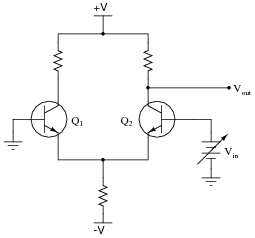
Reveal answerThis is an inverting amplifier.
Notes:Ask your students to remove transistor Q1 (and its collector resistor) from the circuit and try answering the question then. It should be easy to determine whether the circuit is inverting or noninverting in that configuration. Then, have your students “insert” Q1 and its collector resistor back into the circuit and re-analyze. Does the presence of Q1 change anything? Why or why not?