Facebook
 Google
 GitHub
 Linkedin
Discrete Semiconductor Devices and Circuits
Differential Transistor Amplifiers
19 questions By Tony R. Kuphaldt
-
Question 16 of 19
An improvement to the resistor-based differential amplifier design is the addition of a constant-current source where the two transistors’ emitter currents mesh together:

What does the constant-current source “look like” to the rest of the amplifier, in terms of equivalent resistance? What advantage does this give to the amplifier’s performance, over the (simpler) resistor design? Finally, how is this constant-current source actually constructed in a typical differential amplifier circuit?
Reveal answerA constant-current source will “look like” a very large resistance to the rest of the circuit. This gives the amplifier a larger common-mode rejection ratio (CMRR). Usually, the current source is constructed using a current mirror circuit.
Notes:Ask your students to define CMRR and explain its importance in a differential amplifier circuit. Analyze the effects of common-mode input voltage on a simple resistor-based differential amplifier circuit, and then compare it to the circuit having a constant current source. How does the current source work to improve CMRR (reduce common-mode gain)?
Also, have your students draw a current mirror for this differential amplifier circuit and explain how it works.
I am expecting that your students have seen (or can research) the CMRR approximation for a differential pair circuit (CMRR ≈ [(RE)/(r′e)]), and from this can deduce the importance of using a current source in the tail of the circuit instead of a passive resistor.
-
Question 17 of 19
Common-mode rejection ratio is the ratio between a differential amplifier’s differential voltage gain and its common-mode voltage gain:
$$CMRR=\frac{A_{V(diff)}}{A_{V(CM)}}$$
The greater this parameter’s value, the better the differential amplifier will perform as a truly differential amplifier. Combine the equations for differential voltage gain and for common-mode voltage gain for the following differential amplifier circuit, into a single equation for CMRR:
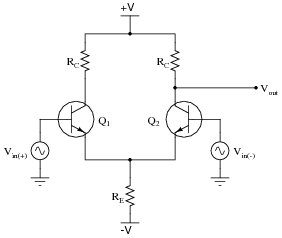
Reveal answer$$CMRR \approx \frac{R_E}{r'_e}$$
Follow-up question: what component value(s) should be altered to maximize CMRR in a differential pair circuit, and why?
Notes:You might want to add that CMRR is usually expressed in decibels, calculated the same way you would calculate decibels for any other ratio of voltages.
-
Question 18 of 19
Differential amplifiers often make use of active loads: a current mirror circuit to establish collector currents between the two transistors, rather than load resistors.
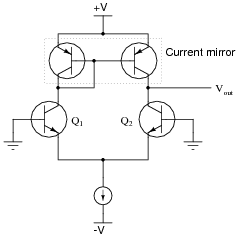
What does the current mirror “look like” to the common-emitter side of the differential amplifier circuit, when we apply the Superposition theorem? What aspect of the differential amplifier’s performance is primarily enhanced with the addition of the current mirror to the circuit?
Reveal answerAdding a current mirror greatly increases the effective resistance on the collector terminal of the common-emitter side, and so greatly increases the amplifier’s differential voltage gain.
Notes:Ask your students to explain why the differential voltage gain increases. One hint is the internal (Norton) resistance of an ideal current source: infinite ohms! Ask your students how this equivalent resistance compares to the (finite) values of the resistors replaced by the current mirror, and what impact that change has on voltage gain.