Facebook
 Google
 GitHub
 Linkedin
Analog Integrated Circuits
Inverting and Noninverting OpAmp Voltage Amplifier Circuits
41 questions By Tony R. Kuphaldt
-
Question 31 of 41
What possible benefit is there to adding a voltage buffer to the front end of an inverting amplifier, as shown in the following schematic?
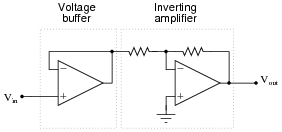
Reveal answerThe voltage buffer raises the amplifier’s input impedance without altering voltage gain.
Notes:Discuss with your students how this is very common: using a voltage buffer as an impedance transformation (or isolation) device so that a weak (high-impedance) source is able to drive an amplifier.
-
Question 32 of 41
Operational amplifier circuits employing negative feedback are sometimes referred to as “electronic levers,” because their voltage gains may be understood through the mechanical analogy of a lever. Explain this analogy in your own words, identifying how the lengths and fulcrum location of a lever relate to the component values of an op-amp circuit:
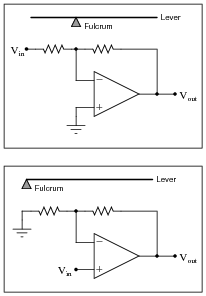
Reveal answerThe analogy of a lever works well to explain how the output voltage of an op-amp circuit relates to the input voltage, in terms of both magnitude and polarity. Resistor values correspond to moment arm lengths, while direction of lever motion (up versus down) corresponds to polarity. The position of the fulcrum represents the location of ground potential in the feedback network.
Notes:I found this analogy in one of the best books I’ve ever read on op-amp circuits: John I. Smith’s Modern Operational Circuit Design
. Unfortunately, this book is out of print, but if you can possibly obtain a copy for your library, I highly recommend it!
-
Question 33 of 41
Compare and contrast inverting versus non-inverting amplifier circuits constructed using operational amplifiers:
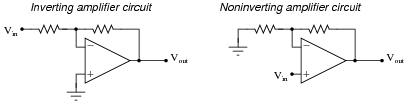
How do these two general forms of opamp circuit compare, especially in regard to input impedance and the range of voltage gain adjustment?
Reveal answerThe non-inverting configuration exhibits a far greater input impedance than the inverting amplifier, but has a more limited range of voltage gain: always greater than or equal to unity.
Notes:Just a simple comparison between amplifier configurations, nothing more. Ask your students to elaborate on the inverting amplifier’s range of gain adjustment: how does it differ from the non-inverting configuration?