Facebook
 Google
 GitHub
 Linkedin
Discrete Semiconductor Devices and Circuits
Signal Modulation
31 questions By Tony R. Kuphaldt
-
Question 4 of 31
A primitive form of communication long ago was the use of smoke signals: interrupting the rising stream of smoke from a fire by waving a blanket over it so that specific sequences of smoke “puffs” could be seen some distance away. Explain how this is an example of modulation, albeit in a non-electronic form.
Reveal answerModulation is the impression of information onto an otherwise featureless stream of matter or energy. In this case, the modulation of a smoke stream by blanket motions should be rather evident.
Notes:It is important for students to understand that modulation is not limited to electronic media. Stranger examples than this may be cited as proof. I once spoke with an engineer specializing in vibration measurement who told me of a very odd application of modulation for data communication. He worked on the design of a vibration sensor that would be embedded in the head of an oil well drill bit. This sensor was supposed to transmit information to the surface, thousands of feet up, but could not use radio or any other “normal” data media because of the distances involved and the harsh environment. The solution taken to this unique problem was to have the sensor activate a valve at the drill head which would modulate the flow of drilling mud up to the surface: a byproduct of the drilling process that had to be pumped up to the surface anyway. By pulsing the normally steady mud flow, digital data could be communicated to pressure sensors at the surface, and then converted into binary data for a computer to archive and translate. Granted, the bit rate was very slow, but the system worked.
An application like this shows how important it is for students to exercise creativity. The really interesting problems in life do not yield to “tried and true” solutions, but can only be overcome through the exercise of creativity and skill. Do everything you can to expose your students to such creative thinking within their discipline(s), and this will help them to become the problem-solvers of tomorrow!
-
Question 5 of 31
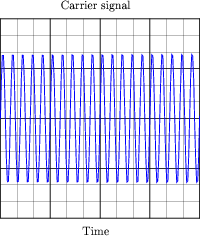
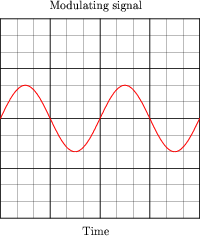
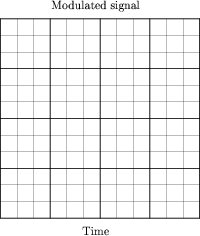
One of the simplest electronic methods of modulation is amplitude modulation, or AM. Explain how a high-frequency carrier signal would be modulated by a lower-frequency signal such as in the case of the two signals shown here in the time domain:
Reveal answer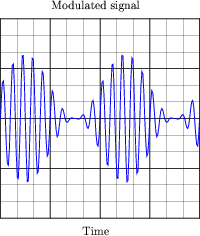
Notes:I do not expect that students will be able to precisely sketch the modulated waveform, especially when the period of the carrier is so short. However, they should be able to express the general idea of amplitude modulation in some form of drawing or sketch, and that’s all I’m interested in seeing from them in response to this question.
-
Question 6 of 31
A circuit often used to amplitude-modulate a carrier signal is a multiplier:
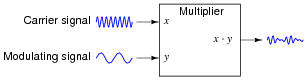
Explain how the instantaneous multiplication of two sine waves results in amplitude modulation. If possible, graph this on a graphing calculator or other computer plotting device.
Reveal answerI’ll let you figure this one out on your own!
Notes:Multiplier circuits are quite useful, and not just for amplitude modulation. The fact that they can be used as amplitude modulators, though, is a concept some students find hard to understand. One illustration that might clear things up is an adjustable voltage divider (since multiplication and division are very closely related):
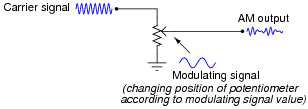
Now, such a potentiometer circuit would be totally impractical for any modulating signal frequency measured in Hertz, as the potentiometer would wear out very rapidly from all the motion. It is the principle of modulated voltage division that this circuit helps to communicate, though. Multiplier circuits do the same thing, only multiplying the amplitude of the carrier signal rather than dividing it.