
 Facebook
 Google
 GitHub
 Linkedin
Discrete Semiconductor Devices and Circuits
Signal Modulation
31 questions By Tony R. Kuphaldt
-
Question 28 of 31
A resistive DC load receives pulse-width modulated (PWM) power from a controller circuit, and an oscilloscope shows the load voltage waveform as such:
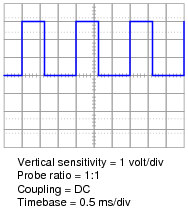
Calculate the duty cycle of this waveform, and also the average power dissipated by the load assuming a load resistance of 2.5 Ω.
Reveal answerDuty cycle ≈ 42%
Paverage ≈ 1.5 W
Follow-up question: which oscilloscope setup parameters (vertical sensitivity, probe ratio, coupling, and timebase) are necessary for performing these calculations? Which parameters are unnecessary, and why?
Notes:Calculating the duty cycle should be easy. Calculating load power dissipation requires some thought. If your students do not know how to calculate average power, suggest this thought experiment: calculating power dissipation at 0% duty cycle, at 100% duty cycle, and at 50% duty cycle. The relationship between duty cycle and average power dissipation is rather intuitive if one considers these conditions.
If a more rigorous approach is required to satisfy student queries, you may wish to pose another thought experiment: calculate the energy (in units of Joules) delivered to the load for a 50% duty cycle, recalling that Watts equals Joules per second. Average power, then, is calculated by dividing Joules by seconds over a period of one or more whole waveform cycles. From this, the linear relationship between duty cycle and average power dissipation should be clear.
-
Question 29 of 31
A resistive DC load receives pulse-width modulated (PWM) power from a controller circuit, and an oscilloscope shows the load voltage waveform as such:
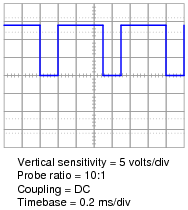
Calculate the duty cycle of this waveform, and also the average power dissipated by the load assuming a load resistance of 40.7 Ω.
Reveal answerDuty cycle ≈ 71.4%
Paverage ≈ 344 W
Follow-up question: which oscilloscope setup parameters (vertical sensitivity, probe ratio, coupling, and timebase) are necessary for performing these calculations? Which parameters are unnecessary, and why?
Notes:Calculating the duty cycle should be easy. Calculating load power dissipation requires some thought. If your students do not know how to calculate average power, suggest this thought experiment: calculating power dissipation at 0% duty cycle, at 100% duty cycle, and at 50% duty cycle. The relationship between duty cycle and average power dissipation is rather intuitive if one considers these conditions.
If a more rigorous approach is required to satisfy student queries, you may wish to pose another thought experiment: calculate the energy (in units of Joules) delivered to the load for a 50% duty cycle, recalling that Watts equals Joules per second. Average power, then, is calculated by dividing Joules by seconds over a period of one or more whole waveform cycles. From this, the linear relationship between duty cycle and average power dissipation should be clear.
-
Question 30 of 31
How is pulse-width modulation power control similar to the form of control exerted by TRIACs and SCRs in AC power circuits? How does it differ?
Reveal answerAs in PWM, AC power control circuits using TRIAC and SCR devices modulate power by controlling the amount of time the load receives power from the source.
Notes:Discuss with your students the similarities and differences between these two forms of time-based power control. Of course, PWM is more sophisticated than naturally-commutated SCR and TRIAC control schemes, but it is also more complex and therefore possibly more prone to faults.


