Facebook
 Google
 GitHub
 Linkedin
Discrete Semiconductor Devices and Circuits
Signal Modulation
31 questions By Tony R. Kuphaldt
-
Question 7 of 31
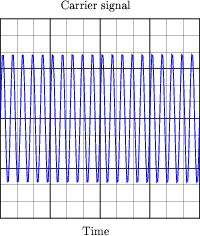
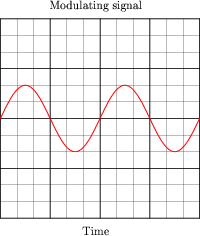
A common modulation technique employed in radio broadcasting is frequency modulation, or FM. Explain how a high-frequency carrier signal would be modulated by a lower-frequency signal such as in the case of the two signals shown here in the time domain:
Reveal answer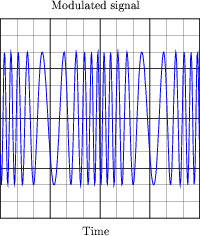
Notes:I do not expect that students will be able to precisely sketch the modulated waveform, especially when the period of the carrier is so short. However, they should be able to express the general idea of frequency modulation in some form of drawing or sketch, and that’s all I’m interested in seeing from them in response to this question.
-
Question 8 of 31
At the heart of an FM transmitter is a circuit called a voltage-controlled oscillator, or VCO. Explain what the purpose of a VCO is, and how this directly relates to frequency modulation.
Reveal answerA VCO generates an AC output signal whose frequency is proportional to an externally-supplied input voltage.
Notes:Note to your students that VCO circuits are not just used in FM radio transmission. They are also essential to the function of phase-locked loops.
-
Question 9 of 31
This is a schematic for a very simple VCO:

The oscillator is of the “Colpitts” design. The key to understanding this circuit’s operation is knowing how the varactor diode responds to different amounts of DC bias voltage. Explain how this circuit works, especially how the diode exerts control over the oscillation frequency. Why does the output frequency vary as the control voltage varies? Does the output frequency increase or decrease as the control voltage input receives a more positive voltage?
Note: “RFC” is an acronym standing for Radio-Frequency Choke, an iron-core inductor whose purpose it is to block radio frequency current from passing through.
Reveal answerAs voltage across the varactor diode changes, its capacitance changes.
The output frequency increases as the control voltage becomes more positive.
Notes:This question is a good review of varactor diode function, as well as frequency modulation theory.