Facebook
 Google
 GitHub
 Linkedin
Discrete Semiconductor Devices and Circuits
Signal Modulation
31 questions By Tony R. Kuphaldt
-
Question 13 of 31
Predict how the output frequency of this voltage-controlled oscillator (VCO) circuit will be affected as a result of the following faults. Consider each fault independently (i.e. one at a time, no multiple faults):
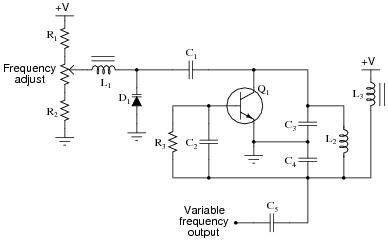
- Capacitor C1 fails open:
- Inductor L1 fails open:
- Resistor R1 fails open:
- Resistor R2 fails open:
- Inductor L2 fails partially shorted:
For each of these conditions, explain why the resulting effects will occur. Note: the voltage-dependent capacitance of a varactor diode is given by the following equation:
$$C_j = \frac{C_o}{\sqrt{2V+1}}$$ - Where,
CJ = Junction capacitance
Co = Junction capacitance with no applied voltage
V = Applied reverse junction voltage
Reveal answer- Capacitor C1 fails open: Output frequency increases.
- Inductor L1 fails open: Output frequency decreases.
- Resistor R1 fails open: Output frequency decreases.
- Resistor R2 fails open: Output frequency increases.
- Inductor L2 fails partially shorted: Output frequency increases.
Notes:The purpose of this question is to approach the domain of circuit troubleshooting from a perspective of knowing what the fault is, rather than only knowing what the symptoms are. Although this is not necessarily a realistic perspective, it helps students build the foundational knowledge necessary to diagnose a faulted circuit from empirical data. Questions such as this should be followed (eventually) by other questions asking students to identify likely faults based on measurements.
-
Question 14 of 31
Determine the duty cycle of this square wave signal:
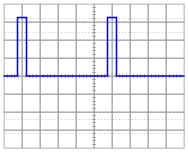
Reveal answerDuty cycle ≈ 10%
Notes:This question challenges students to apply their knowledge of duty cycle to a measurement scenario.
-
Question 15 of 31
Determine the duty cycle of this square wave signal:
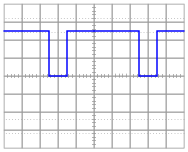
Reveal answerDuty cycle ≈ 80%
Notes:This question challenges students to apply their knowledge of duty cycle to a measurement scenario.