Facebook
 Google
 GitHub
 Linkedin
DC Electric Circuits
Time Constant Circuits
23 questions By Tony R. Kuphaldt
-
Question 19 of 23
Design a circuit with a three-position switch, where one position charges a capacitor, one position holds the capacitor’s voltage constant, and the last position discharges the capacitor. Provide independent, variable adjustments for charging and discharging time constants.
Reveal answerThe following circuit does not meet all the design criteria, but it gives you an idea of where to begin in your design:

Notes:This is an interesting question, as the students are challenged with the design of a circuit, and that the example circuit shown in the answer does not completely fulfill the specified criteria. In order for a student to derive a circuit from the one given in the answer, they must first assess that circuit’s operation, to determine what it can and cannot do.
Note that it will not suffice to merely replace the fixed-value resistor with a variable resistor, as this would not provide independent adjustment of charging and discharging time constants.
-
Question 20 of 23
An intervalometer is a device that measures the interval of time between two events. Such devices are commonly used to measure the speed of projectiles, given a known distance between two sensors:

A crude intervalometer may be constructed using two thin wires as sensors, which are broken by the passage of the projectile. The two wires are connected in an RC circuit as such:

In order for this circuit to function properly as an intervalometer, which wire does the projectile need to break first? Explain why. Also, the voltmeter used in this instrument must be one with as high an input resistance as possible for best accuracy. Explain why this is necessary as well.
Which will produce a greater voltage indication after the test, a fast projectile or a slow projectile? Explain your answer.
Reveal answerWire #1 needs to be closest to the projectile source (the gun), while wire #2 needs to be further downrange.
Notes:This is an interesting question because it requires the students to reason through the function of a practical measuring circuit. Not only must students grasp the charge/discharge behavior of a capacitor, but they also must relate it to the practical purpose of the intervalometer, recognizing the importance of voltmeter characteristics as well. Expect substantial discussion on this question.
-
Question 21 of 23
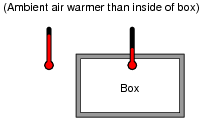
Suppose we were measuring the interior temperature of an insulated box recently removed from a refrigerator, as it was being warmed by the ambient air around it:
Graphing the box’s temperature over time, we see a curve that looks something like this:
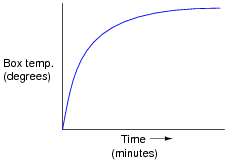
An engineer approaches you and says she wants you to build an electrical circuit that models this thermal system. What kind of circuit would you consider building for the engineer, to make a realistic electrical analogue of the box’s temperature? Be as specific as you can in your answer.
Reveal answerUsually, voltage is the electrical variable used to represent the physical quantity being modeled (in this case, temperature), so we need a circuit where voltage starts to increase rapidly, then gradually approaches a maximum value over time.
I won’t show you a schematic diagram for the correct circuit, but I will give you several hints:
- •
- The circuit uses a capacitor and a resistor.
- •
- It is sometimes referred to as a passive integrator circuit.
- •
- Engineers sometimes refer to it as a first-order lag network.
- •
- You’ve seen this circuit before, just not in the context of modeling a physical process!
Notes:I like to show this question to beginning students because it shows them an aspect of electrical circuits that they probably never thought to consider: that the behavior of a circuit might mimic the behavior of some other type of physical system or process, and that this principle might be exploited as a modeling tool for engineers. Before the advent of inexpensive digital computers, the analog computer was the simulation tool of choice among engineers of all persuasions. Using resistors, capacitors, and amplifier circuits, these marvelous machines modeled all kinds of physical systems, as electrical constructs of mathematical equations.
But even without knowing anything about calculus, amplifier circuits, or any advanced electronic concepts, beginning students should be able to understand the principle at work in this question.