
 Facebook
 Google
 GitHub
 Linkedin
DC Electric Circuits
Voltage Divider Circuits
37 questions By Tony R. Kuphaldt
-
Question 31 of 37
Size the resistor in this voltage divider circuit to provide 5 volts to the load, assuming that the load will draw 75 mA of current at this voltage:

As part of your design, include the power dissipation ratings of both resistors.
Reveal answerR = 264 Ω. The 330 Ω resistor must have a power dissipation rating of at least 3 watts, while the 264 Ω resistor will fare well even with a (low) power dissipation rating of 1/8 watt.
Notes:Ask your students what would change in this divider circuit if the load were to suddenly draw more, or less, current.
-
Question 32 of 37
Size both resistors in this voltage divider circuit to provide 6 volts to the load, assuming that the load will draw 7 mA of current at this voltage, and to have a “bleeder” current of 1 mA going through R2:

As part of your design, include the power dissipation ratings of both resistors.
Reveal answerR1 = 750 Ω and R2 = 6 kΩ. 1/8 watt resistors are perfectly adequate to handle the dissipations in this circuit.
Notes:This may seem like a tricky problem to some students, as though it is lacking in information. All the necessary information is there, however. Students just need to think through all the laws of series-parallel circuits to piece together the necessary resistor values from the given specifications.
-
Question 33 of 37
Explain what will happen to the first load’s voltage and current in this voltage divider circuit, as a second load is connected as shown:
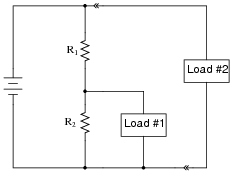
Reveal answerIdeally, the first load’s voltage and current will remain unaffected by the connection of load #2 to the circuit. In reality, there will inevitably be a slight sag in the load voltage though, because the voltage source is bound to have some internal resistance.
Notes:It is important for students to realize that the second load constitutes a separate parallel branch in the circuit, which (ideally) has no effect on the rest of the circuit.






Plus signs are missing from these questions and answers, such as in question 11, where the denominator of the voltage divider equation appears as “R1 R2 R3” instead of “R1+R2+R3”. Same in the answer to question 15. Likely elsewhere as well, as Find shows no results for “+” anywhere on the page. I’m using Chrome 88.0.4324.182 on Windows 10, but same on Firefox & Edge. HTML source for the page shows it as “R1 R2 R3”, so it isn’t just a display problem.
Iam a student and i need an explain for this answers how can I get an explanation ?
Ca any one tell in detail how
The formula got formed like this !! ( ER= Et(R/Rt)) thank you