
 Facebook
 Google
 GitHub
 Linkedin
DC Electric Circuits
Voltage Divider Circuits
37 questions By Tony R. Kuphaldt
-
Question 4 of 37
Determine the amount of voltage dropped by each resistor in this circuit, if each resistor has a color code of Brn, Blk, Red, Gld (assume perfectly precise resistance values - 0% error):
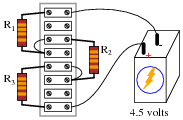
Also, determine the following information about this circuit:
- Current through each resistor
- Power dissipated by each resistor
- Ratio of each resistor’s voltage drop to battery voltage ER/Ebat
- Ratio of each resistor’s resistance to the total circuit resistance R/Rtotal
Reveal answerVoltage across each resistor = 1.5 V
Current through each resistor = 1.5 mA
Power dissipated by each resistor = 2.25 mW
Voltage ratio =\(\frac{1}{3}\)
Resistance ratio =\(\frac{1}{3}\)
Follow-up question: are the two ratios’ equality a coincidence? Explain your answer.
Notes:When performing the mathematical analysis on this circuit, there is more than one possible sequence of steps to obtaining the solutions. Different students in your class may very well have different solution sequences, and it is a good thing to have students share their differing problem-solving techniques before the whole class.
An important aspect of this question is for students to observe the identical ratios (voltage versus resistance), and determine whether or not these ratios are equal by chance or equal by necessity. Ask your students, “What kind of evidence would prove these ratios were merely equal by chance?” Setting mathematics aside and viewing this circuit from a purely experimental point of view, ask your students what data could possibly prove these ratios to be equal by chance in this particular case? Hint: it would only take a single example to prove this!
-
Question 5 of 37
Calculate the voltage dropped by each of these resistors, given a battery voltage of 9 volts. The resistor color codes are as follows (assume 0% error on all resistor values):
- R1 = Brn, Grn, Red, Gld
- R2 = Yel, Vio, Org, Gld
- R3 = Red, Grn, Red, Gld
- R4 = Wht, Blk, Red, Gld
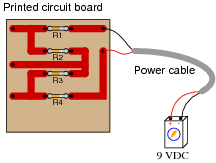
Now, re-calculate all resistor voltage drops for a scenario where the total voltage is different:
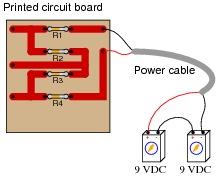
Reveal answerFirst scenario: Second scenario: ER1 = 0.225 volts ER1 = 0.45 volts ER2 = 7.05 volts ER2 = 14.1 volts ER3 = 0.375 volts ER3 = 0.75 volts ER4 = 1.35 volts ER4 = 2.7 volts Follow-up question: what do you notice about the ratios of the voltages between the two scenarios?
Notes:Ask your students if they notice any pattern between the voltage drops of the first scenario and the voltage drops of the second scenario. What does this pattern tell us about the nature of voltage divider circuits?
-
Question 6 of 37
Design a voltage divider circuit that splits the power supply voltage into the following percentages:

Reveal answerThere are many different sets of resistor values that will achieve this design goal, but here is one pair of resistance values that will suffice:
250 Ω and 750 Ω Notes:Different students will likely arrive at different solutions for this design task. Have your students share their differing solutions, emphasizing that there is often more than one acceptable solution to a problem!





Plus signs are missing from these questions and answers, such as in question 11, where the denominator of the voltage divider equation appears as “R1 R2 R3” instead of “R1+R2+R3”. Same in the answer to question 15. Likely elsewhere as well, as Find shows no results for “+” anywhere on the page. I’m using Chrome 88.0.4324.182 on Windows 10, but same on Firefox & Edge. HTML source for the page shows it as “R1 R2 R3”, so it isn’t just a display problem.
Iam a student and i need an explain for this answers how can I get an explanation ?
Ca any one tell in detail how
The formula got formed like this !! ( ER= Et(R/Rt)) thank you