
 Facebook
 Google
 GitHub
 Linkedin
AC Electric Circuits
AC Motor Control Circuits
23 questions By Tony R. Kuphaldt
-
Question 7 of 23
The circuit shown here provides two-direction control (forward and reverse) for a three-phase electric motor:

Explain how the reversal of motor direction is accomplished with two different motor starters, M1 and M2. Also, explain why there is only one set of overload heaters instead of two (one for forward and one for reverse). Finally, explain the purpose of the normally-closed contacts in series with each starter coil.
Reveal answerMotor reversal is accomplished by reversing the phase sequence of the three-phase power going to the motor (from ABC to ACB). The existence of only one set (three) heaters may be adequately explained if you consider a scenario where the motor overheats after being run in the “Forward” direction, then an immediate attempt is made to run it in “Reverse.” Finally, the NC contacts (typically called interlock contacts) prevent lots of sparks from flying if both pushbuttons are simultaneously pressed!
Notes:Ask your students to explain exactly why “sparks [would fly]” if both pushbuttons were pressed at the same time. The name commonly given to the NC contacts is interlock, because each one “locks out” the other starter from being energized.
-
Question 8 of 23
The starter and overload heater assembly for an industrial electric motor is often located quite a distance from the motor itself, inside a room referred to as a motor control center, or MCC:
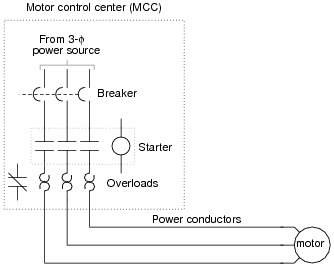
Since it is impossible for a technician to be in two places at once, it is often necessary to perform diagnostic checks on a malfunctioning electric motor from the MCC where the technician has access to all the control circuitry.
One such diagnostic check is line current, to detect the presence of an open motor winding. If a three-phase motor winding fails open, the motor will not run as it should. This is called single-phasing. A good way to check for this condition is to use a clamp-on (inductive) ammeter to check line current on all three lines while the starter is energized. This may be done at any location where there is physical access to the motor power conductors.
Suppose, though, you are working on a job site where single-phasing is suspected and you do not have a clamp-on ammeter with you. All you have is a DMM (digital multimeter), which does not have the ability to safely measure the motor’s current. You are about to head back to the shop to get a clamp-on ammeter when a more experienced technician suggests an alternate test. He takes your DMM, sets it to the AC millivolt range, then connects the test probes to either side of each overload heater element, one heater at a time like this:

Across each overload heater element he measures about 20 mV AC with the starter engaged. From this he determines that the motor is not single-phasing, but is drawing approximately equal current on all three phases.
Explain how this diagnostic check works, and why this determination can be made. Also describe what limitations this diagnostic procedure has, and how a clamp-on ammeter really is the best way to measure motor line current.
Reveal answerEach overload heater element possesses a small amount of electrical resistance, which is the key to this diagnostic procedure. Of course, the measurement obtained is strictly qualitative, not quantitative as a clamp-on ammeter would give.
Follow-up question #1: what sort of result might occur with this diagnostic check if the motor were indeed single-phasing due to one of the overload heaters failing open?
Follow-up question #2: what other causes could there be for a three-phase motor “single-phasing” other than a motor winding failed open?
Notes:I have used this diagnostic check more than once to troubleshooting a single-phasing electric motor. It is amazing what sorts of diagnostic checks you can do with a high-quality DMM and a sound understanding of electrical theory!
-
Question 9 of 23
A popular strategy for AC induction motor control is the use of variable frequency drive units, or VFDs. Explain what varying the frequency of power to an AC induction motor accomplishes, and why this might be advantageous.
Reveal answerVariable frequency drives allow for the precise and efficient control of induction motor speed, which is not possible by other means.
Notes:Central to the answer of this question is the principle of a rotating magnetic field and how rotor speed is primarily a function of line frequency. While the internal details of a VFD are quite complex, the basic operating principle (and rationale) is not.




Hello, sir.
Please share the name of the Source material/ Text book used in this Article. I will be very thankful to you.
Thanks for doing such a great job.
Good day.
Please I’m Benjamin Akrofi and I need answers to question 8
The name of the site I saw the question is ALL ABOUT CIRCUITS