
 Facebook
 Google
 GitHub
 Linkedin
AC Electric Circuits
AC Motor Control Circuits
23 questions By Tony R. Kuphaldt
-
Question 10 of 23
Shown here is a typical set of “curves” for an overload heater, such as is commonly used to provide overcurrent protection for AC electric motors:
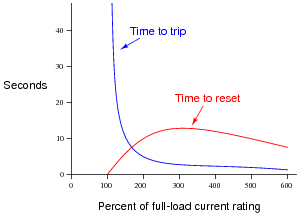
Why is there any time required to re-set an overload heater contact after a “trip”? Circuit breakers can be re-closed mere moments after a trip with no problem, and fuses (of course) can be replaced moments after blowing. Is this an intentional design feature of overload heaters, or just an idiosyncrasy?
Also, explain why the reset curve starts to decrease for currents above 300% of the motor’s full-load rating. Why doesn’t the reset time curve continue to increase with increasing fault current magnitudes?
Reveal answerThe reset time for an overcurrent heater is an intentional design feature. If the heater is too hot to re-set, then the motor is too hot to re-start.
Notes:Remind your students that the purpose of an overload heater is to provide a thermal analogue of the electric motor itself. Ideally, the heater heats up and cools down at the exact same rate as the motor. This explains why there is a necessary reset time after an overload heater causes the motor control circuit to “trip.”
Ask your students to share the common design features of an overload heater, from their research. How do these devices actually function? If your students understand this, they should have no difficulty understanding why overload heater contacts require time to reset after a trip.
The reason for the reset time curve decreasing after about 300% full-load current is a bit more complex to answer. This, as well, is not an idiosyncrasy, but rather a design feature of the overload heater. Since greater levels of current will trip the heater in a shorter time, they actually heat up the motor less during that brief “on” time than a sustained overcurrent of lesser magnitude. Therefore the motor does not need to cool down as long prior to the next re-start.
-
Question 11 of 23
Protective relays are special power-sensing devices whose job it is to automatically open or close circuit breakers in large electric power systems. Some protective relays are designed to be used directly with large electric motors to provide sophisticated monitoring, shut-down, and start-up control.
One of the features of these motor-oriented protective relays is start-up lockout. What this means is the relay will prevent someone from attempting too many successive re-starts of a large electric motor. If the motor is started and stopped several times over a short period of time, the relay will prevent the person from starting it again until a sufficient “rest” time has passed.
Explain why a large electric motor would need to “rest” after several successive start-up events. If electric motors are perfectly capable of running continuously at full load for years on end, why would a few start-ups be worthy of automatic lock-out?
Reveal answerI won’t give you a direct answer here, but I will provide a big hint: inrush current.
Notes:Inrush current is a factor with every motor type, AC or DC. It is easy to forget just how substantially larger a typical motor’s inrush current is compared to its normal full-load current. When students consider the magnitude of the currents involved, and also the fact that most electric motors are fan-cooled and therefore lacking in cooling during the initial moments of a start-up, the reason for automatic lock-out after several successive start-up events becomes obvious.
-
Question 12 of 23
Electromechanical relays used to start and stop high-power electric motors (called “contactors” or starters”) must be considered a possible source of arc flash. Explain why this is. What is it about the construction or operation of such a relay that invites this dangerous phenomenon?
Reveal answerElectromechanical relays interrupt circuit current by drawing pairs of metal contacts apart, separating them with an air gap. Because this contact motion is not instantaneous, it is possible to generate an arc across the air gaps of such magnitude that it becomes an arc flash.
Notes:Arc flash is just as hazardous to electrical technicians as electric shock, yet I have seen (and worked with) people who pay no attention to the dangers! It must be understood that motor starters are by their very nature arc-generating devices, and that under certain unusual conditions may generate lethal arc flashes. You might want to ask your students what sorts of unusual conditions could lead to a contactor producing an actual arc flash (rather than merely a few small sparks).






Hello, sir.
Please share the name of the Source material/ Text book used in this Article. I will be very thankful to you.
Thanks for doing such a great job.
Good day.
Please I’m Benjamin Akrofi and I need answers to question 8
The name of the site I saw the question is ALL ABOUT CIRCUITS