
 Facebook
 Google
 GitHub
 Linkedin
Discrete Semiconductor Devices and Circuits
Bipolar Junction Transistor (BJT) theory
28 questions By Tony R. Kuphaldt
-
Question 13 of 28
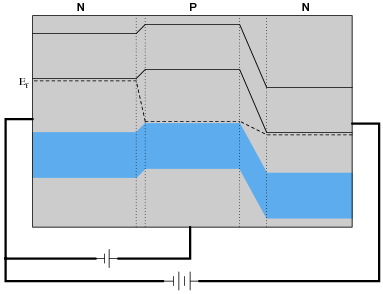
Trace the paths of injection, diffusion, and collection currents in this energy diagram for an NPN transistor as it is conducting:
Reveal answer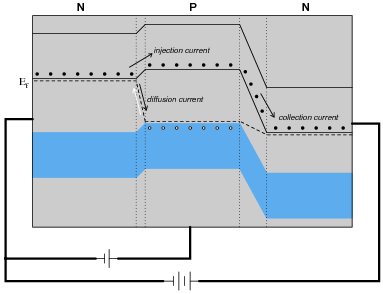
Notes:A picture is worth a thousand words, they say. For me, this illustration is the one that finally made transistors make sense to me. By forward-biasing the emitter-base junction, minority carriers are injected into the base (electrons in the “P” type material, in the case of an NPN transistor), which then fall easily into the collector region. This energy diagram is invaluable for explaining why collector current can flow even when the base-collector junction is reverse biased.
-
Question 14 of 28
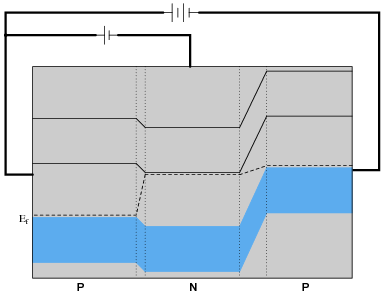
Trace the paths of injection, diffusion, and collection currents in this energy diagram for a PNP transistor as it is conducting:
Reveal answer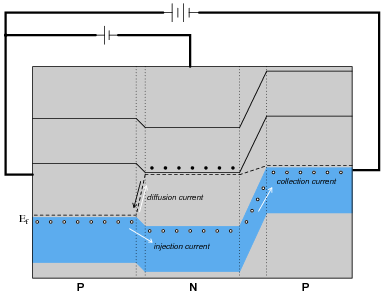
Notes:A picture is worth a thousand words, they say. For me, this illustration is the one that finally made transistors make sense to me. By forward-biasing the emitter-base junction, minority carriers are injected into the base (holes in the “N” type material, in the case of a PNP transistor), which then rise easily into the collector region. This energy diagram is invaluable for explaining why collector current can flow even when the base-collector junction is reverse biased.
When looking at energy diagrams, it is helpful to think of natural hole motion as air bubbles in a liquid, trying to rise as high as possible within their designated band.
-
Question 15 of 28
From an examination of the energy diagram for a BJT in its conducting mode (current existing through each of the three terminals: emitter, base, and collector), determine the biasing of the two PN junctions:
- The emitter-base junction (forward or reverse biased?)
- The base-collector junction (forward or reverse biased?)
One of these two junctions actually operates in the reverse-bias mode while the transistor is conducting. Explain how this is possible, as a simple PN junction (a diode) operating in reverse-bias mode conducts negligible current.
Reveal answerThe emitter-base junction is forward-biased, while the base-collector junction is reverse-biased. Collector current is made possible across the base-collector junction by the presence of injected charge carriers from the emitter.
Notes:This question is possible to answer only if one understands the energy levels inside a BJT. The most common explanations of BJT function I find in introductory (non-engineering) textbooks completely omit discussions of energy levels, making the subject very confusing to new students.






What surprises me is the following: I did not see any mentioning of the most important BJT parameter: Transconductance gm.
(Instead, you are stating that the beta-value would be a very important parameter - which is NOT the case!).
Like some other low-level electronic books and papers you treat the BJT as a cittent-controlled device - this is simply wrong.
There is not a single proof that the BJT would be a CCCS !
However, there are many theoretical explanations, measurements and observable facts which clearly show that the BJT is - of course - voltage-controlled. Who can deny it ? With which arguments? Ic=beta x Ib is just a formula - a misinterpretation of Ib=Ic/beta.